
Last Updated: September 1, 2026
The word ‘startup’ is a word that has exploded in popularity in the business community. Between new technology ventures, novel products, new online services, new internet applications, the idea of startup, startups and becoming a startup has redefined the understanding of enterprise.
But precisely what is a startup?
Is all small business a startup?
Now what do we exactly mean by a startup, and in what sense, is it different from any ordinary company? What actually goes into making a startup and what is actually involved in building a startup?
A startup, generally speaking, is an emerging business and is created in pursuit of solving a problem or filling an unaddressed market niche by way of a new technology-based product or service.
Unlike most traditional small businesses, a startup usually has an intent to create and deliver a business model that can scale very fast without ever dramatically scaling costs.
The growth of startup firms has been hugely facilitated, as previously stated, by advancements such as: the internet, cloud computing, mobile devices, artificial intelligence, digital money, and social networks enabling entrepreneurs to form businesses with significantly less resources available in the past.
We are probably all aware of many business startups that became huge corporations and are very well-known such as: Airbnb, Spotify, Uber, and Amazon. Learning about business startups may lead you to make certain conclusions about the ability and nature of the entrepreneur and whether the business startup is the type of venture for you in entrepreneurship.
This article belongs to How to Start
Table of Contents
What Is a Startup?
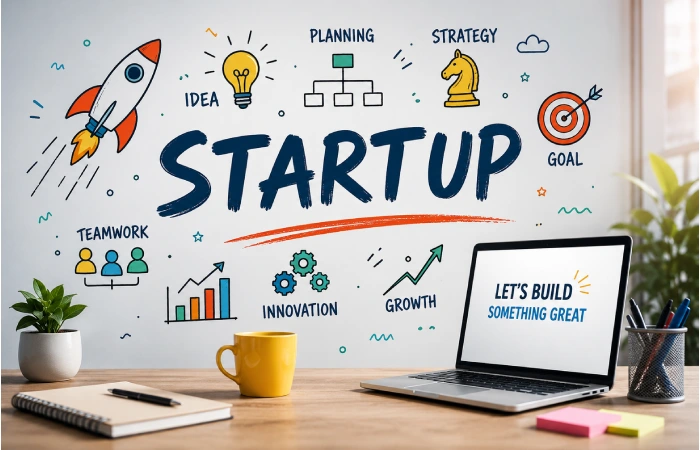
A startup is a young, nascent company that is established with the purpose of producing and testing a new product, service or business concept that could potentially go far.
The key is that a startup is more than just a company that was recently founded. A new restaurant, accounting firm, clothing shop, or repair service down the street might be a “new business” but it’s not necessarily a “startup.”
Startups live in an uncertain environment. Founders may have an idea of what customers want and how to provide that value, but how do you determine if those customers will use or pay for it?
Because of that, most startups are constantly trying out their products, the price, marketing tactics, and their fundamental business model as they grow.
A startup might begin with a few people and an unfinished product, and after they find out that other people are interested, they’ll begin to scale up from there.
For a broader overview of the topic, understanding the key information about startups can help new entrepreneurs see how these businesses differ from traditional companies.
What Makes a Business a Startup?
Here are few points to define a start-up which is very different from a new business.
- It tries to solve a purpose, and a relevant problem.
- It often introduces a new or improved solution.
- It operates with considerable uncertainty.
- It aims for a scalable business model.
- Technology often plays an important role.
- It seeks to reach a large market.
- We might need outside funding to scale.
- test and iteration on the product or service always.
Definition the exact definition is relative industry but the most typical qualities attributed to start ups is Innovation potential, Scale, Experimentation, Growth.
Is Every New Business a Startup?
No.
This is probably the most popular misconception about startups.
For instance, a person may start up their own local bakery in their town. A small local business with a few dozen regular clients may not have the aspiration to open up hundreds of bakeries nor build a technology-company style business. However, there’s another example of someone who develops a business that connects independent bakers to customers in hundreds of different cities online.
The technology has the potential of addressing thousands and thousands of customers without the actual company having a store in each city.
That entrepreneur’s example is often identified by many as a tech startup model as it contains the traits necessary to scale up very efficiently and to possibly growth at very rapid paces.
Therefore, being “new” is by itself the only requirement for a business to be called a startup.
Startup vs. Traditional Company
Both startups and old firms can produce items/provide services and make money in the end, their objectives could be completely different.
1. Growth
A startup is looking to grow and do so quickly.
A traditional, typical small business is likely to aim at a stable growth on a well-defined region of space or market.
For example, a local accounting firm may service hundreds of local companies successfully for many years without ever really setting a goal to be a global enterprise.
On the contrary, however, a software startup might also come up with a digital product that could later be sold to customers the world over.
2. Business Model
Traditional companies typically operate with pre-existing business models.
Startups typically experiment with several models in an attempt to find out where to extract and appropriate value from.
The startup can experiment with pricing subscriptions, ads, commissions, free software, selling direct, market places, a mix of these, etc. Till one gets right.
3. Scalability
Perhaps the most significant distinction between the two: Scalability
A business that is scalable can grow in terms of revenue more dramatically than costs increase.
Highly scalable Digital products tend to be very scalable; once a company has created the software, they may be able to give it to tens or hundreds of additional thousands of clients with little expense and without making another physical copy of the product.
4. Risk or Uncertainty
Start-up entrepreneurs work under a higher level of uncertainty.
Founders may not know for sure who the target customer will be, which features the customer will want the most, how much will be willing to pay for the product or service, and whether the business model itself will fly.
It is of course possible that traditional businesses have some level of uncertainty but they tend to operate on business models that have already worked in the market.
5. Financing
Several startups often look for funding from outside sources to help grow their business fast.
The sources a business founder uses is based upon the type of business and they may be private savings, debt finance, angel or venture capital, crowdfunding, grants and even money provided by the business’s own earnings and income generation.
If traditional small companies do resort to external financing they generally will focus to become profitable through their revenues rather than on expanding quickly financed from outside investors.
Key Characteristics of a Startup
The way in which the business model operates can be better understood once the nature of a startup is defined.
1. Young
Many startups are relatively young companies.
Normally developed with reference to a new product, idea, technology, opportunity or market. The age of your business itself will not determine if it’s a start-up business.
Companies will seem like startups for years if still looking for a repeatable and scalable business model.
2. Scalable
Scalability is a key feature of the startup model.
A scaling startup can grow significantly in customers and revenue without a proportional cost increase.
Let’s say an online software platform may gain thousands more customers, and still run pretty much on same infrastructure.
This does not mean every startup becomes highly profitable. A start-up could be heavily financed with considerable revenues but be spending heavily on developing the product; marketing activities; employing staff; infrastructure to support such staff; and expansion.
3. Innovative
But another feature is this ‘innovation’.
Innovation can also come as inventing something new.
A startup could innovate by:
- Creating a new product.
- Improving an existing product.
- Changing how a service is delivered.
- Making a process faster.
- Reducing costs.
- Improving customer experience.
- Creating a new marketplace.
- Applying existing technology to a new problem.
The goal is to provide customers with a reason to choose the startup’s solution.
4. Technology-Driven
Many modern startups use technology as a core part of their operations.
The following examples of this category include:
- Software platforms
- Mobile applications
- Artificial intelligence
- Cloud computing
- E-commerce
- Fintech
- Digital healthcare
- Online education
- SaaS products
- Digital marketplaces
However, a startup does not have to be purely technological. Startups are also a staple in foods manufacturing, education, health, technology, agriculture, retail, transportation as well as logistics.
5. Problem-Focused
Every successful startup starts off in first place with a problem which never just an idea.
Entrepreneurs should ask questions as follows:
What problem am I solving?
The best startup ideas have a problem that customers need to solve.
For example, Airbnb noticed how people wanted other accommodation options and it made a platform where travellers are put in touch with property hosts.
6. Disruptive
Some startups disrupt established industries by introducing a different approach.
Disruption may involve changing:
- Pricing
- Distribution
- Customer service
- Product design
- Purchasing methods
- Delivery systems
- Communication
- Access to services
Not all startups need to be game changers. You might win the game by producing a better version of existing tech and by serving previously under-served customers.
7. Experimental
In the process of creating a startup, you don’t know anything.
You learn by testing your assumptions with prototypes, customer conversations, landing pages, MVPs, advertising tests and sales.
Testing tells you what not to spend money on.
What Is a Scalable Startup?
A scalable startup is a venture that can dramatically expand, while sustaining the business structure which was built in order to handle demand as it expands.
Consider software as a service subscription.
If you had 100 customers, you might have limited costs for support structure, with technology.
If you have 10,000 customers you will necessarily have a higher cost, but ideally not 10,000x greater.
This is the basic idea of scalability, start-ups utilizing technology to standardize tasks as much as possible; deliver their product electronically, and target a global customer base.
What Is a Startup’s Minimum Viable Product?
Here, is a fundamental term for startups’ development: a Minimum Viable Product (MVP).
MVP is an early version of the product and has enough features to get the most learning about customers’ acceptance with its solution, instead of months or years on the creation of a perfect product before contacting its first customer.
For example, an aspiring developer who wants to launch an elaborate food-delivery Web site may begin with just one zone and simple order placing.
The purpose is to answer important questions:
- Do customers want the service?
- Will they use it repeatedly?
- Will they pay for it?
- Which features matter most?
- Can the business acquire customers at a sustainable cost?
The answers can guide future product development.
How Startups Make Money?
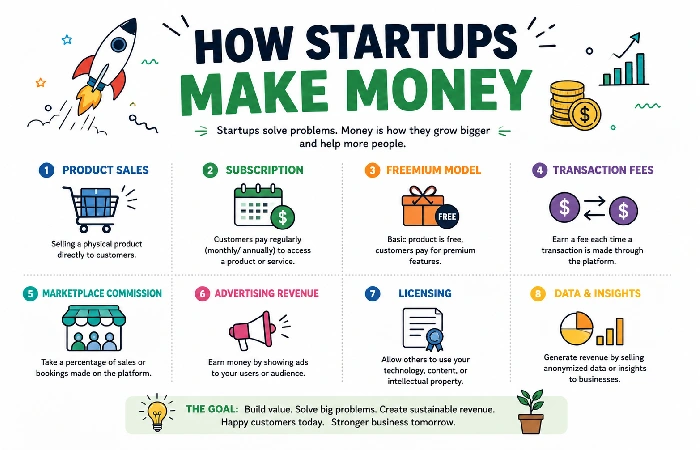
A startup must find an ethical method of accumulating income.
Common startup business models include:
Subscription
Customers make frequent payments for a product or service; say, on a monthly basis or perhaps annually.
Marketplace Commission
The startup connects buyers and sellers and receives a percentage of transactions.
Advertising
The product may be free for users while businesses pay to advertise.
Freemium
Basic features are available for free while advanced features require payment.
Direct Sales
The startup sells products or services directly to customers.
Usage-Based Pricing
The model involves charging the customers based on their utilization.
A wrong selection of business model can prevent a startup that is serving a greater number of users from generating enough revenue to sustain.
How Startups Get Funding?
Money allowed startups to create products, hire employees, market services, and enter new markets.
Some common funding sources contain:
Bootstrapping
Bootstrapping is essentially funding the company out of either the founder’s pocket, or the early profits of the business.
While this can give founders more control, it might restrict the speed with which the business grows.
Friends and Family
Some entrepreneurs raise their initial capital from people they know.
Angel Investors
Angel investors are individuals that make use of their own funds for start-ups.
Venture Capital
Venture capital firms invest their capital with the hope and prediction of becoming quite a substantial business someday soon.
Typically, investors get an ownership stake.
Crowdfunding
Businesses can make this funding available to the public on crowdfunding sites in exchange for rewards.
Loans and Other Financing
Entrepreneurs can also resort to sources like bank loans, government schemes, grants and others based upon their respective business and location.
However, not every startup requires a venture capital fund; some ventures grow on their own by revenue and bootstrapping, etc.
Three Successful Companies That Started as Startups
Some prominent examples are available across the world about how a start up can become the market giant it is today.
Uber
Initially, Uber was just a platform focused on connecting riders and drivers.
However, the app created a new standard of requesting rides as more users started to demand transportation from Uber using its mobile platform, and, in time, the company expanded beyond ride sharing and included other business sectors like food delivery.
Uber’s exponential growth serves as an example of how a platform can reach a wider audience connecting different users through one digital marketplace.
Airbnb
So, Airbnb then built a two-sided market to connect travellers to individuals who had houses that they were able to Airbnb out.
Instead of establishing brick and mortar hotels in every city they decided they could build a digital marketplace to let hosts showcase what was available and where.
This platform approach let Airbnb scale to reach a global audience using only a network of local partners.
Spotify
Spotify has created a digital music-streaming service which in many cases has revolutionised how people can access music.
The system does not mean the customer has to buy each separate album in its physical form. The service now offers millions of songs available on its platform for customers to stream directly.
This gives an example of how technology has changed a traditional business, by changing a company’s product availability strategy to fit that of a customer base now preferring instant access.
Other Famous Startup Examples
Many other companies began with startup characteristics before becoming large organizations.
For Example:
- Amazon
- Microsoft
- Apple
- Netflix
- Dropbox
- Canva
- Slack
- Zoom
Though operating in varying fields, many of the mentioned businesses seemed to possess a few similarities: finding an opportunity, creating solutions, exploring different models and striving for substantial growth.
Their history also shows that start-ups can arise from vastly different concepts and fields.
How to Start setting up a Startup
An interesting idea alone isn’t going to establish your start-up. Before moving into the execution stages, entrepreneurs should understand the key considerations involved in starting up a company.
To build a startup, you need to identify customer’s true problem, study your customers extremely in depth, test your presumptions with existing people, establish a resolution, find out to get money (business model) and discover to grow it up (strategy).
For entrepreneurs ready to move from an idea to execution, this guide to starting a startup provides a useful next step alongside the process below.
Here are basic ways to build and to develop a startup:
Step 1: Find the Problem
Start with a problem, don’t “what business should I start” jumping out!
Figure out the everyday problems that are causing discomfort to others.
Go talk to your prospects and find out their wants and pain-points.
A useful problem should ideally be:
- Important
- Frequent
- Expensive or inconvenient
- Experienced by a clearly identifiable group
- Currently underserved by existing solutions
Step 2: Research the Market
Entrepreneurs can also review the SBA’s business planning resources for guidance on market research, business plans, startup costs, and funding.
Before investing significant money, study the market.
Careful planning a startup company can help founders organize market research, resources, finances, and growth objectives before making major investments.
Research:
- Potential customers
- Competitors
- Market size
- Pricing
- Existing solutions
- Customer complaints
- Industry trends
- Barriers to entry
Competition is not necessarily a bad sign. In many cases, competition shows customers actually spend money on solving the problem. Perhaps you just have to be better, faster, cheaper, or more convenient to make that kind of decision on it.
Step 3: Explain Your Target Customer
Don’t try to sell to everybody.
Find out who your ideal customer is
For instance, rather than, “my product is for business” it would be more effective, and less to focus on for development and marketing, to narrow the audience down to the ideal customer, which might be:
“Small online retailers that are struggling with managing inventory cost-effectively”
Step 4: Develop Your Solution
Now that you have a grasp of problem and customer, build your solution.
At this point in the game, concentrate your efforts on addressing the primary pain point. It’s not about creating a list of features (often a list of dozens of features).
Ask:
What’s the most minimal solution the most obvious problem of the customer?
Step 5: Create an MVP
Build a Minimum Viable Product.
The goal of a MVP isn’t to become rich or to do business but to enable you to validate your assumptions, and for us that may come in the form of any product, be it software, a landing page, any service you can deliver, a prototype or even done manually.
Step 6: Test With Real Customers
We highly appreciate customer comments.
Observe:
- Whether people use the product.
- Which features they like.
- Where they experience difficulties.
- Whether they return.
- Whether they recommend it.
- Whether they are willing to buy.
Don’t fully trust what you hear people say they will do. Actual customer behaviour provides stronger evidence.
Step 7: Create a Business Model
Regulate how your startup will make money.
Consider:
- Pricing
- Revenue sources
- Customer acquisition costs
- Operating expenses
- Gross margins
- Recurring revenue
- Distribution costs
However good the product may be, a business idea doesn’t survive if it hasn’t got an economic basis.
Step 8: Build Your Members
Founders can’t always do it by themselves.
Depending on the kind of startup, you are also going to want a startup team that has the knowledge of:
- Product development
- Technology
- Sales
- Marketing
- Finance
- Operations
- Customer support
- Design
In the early days, though, it’s best to focus on the team. Avoid unnecessary hiring at first.
Step 9: Create the Business Legally
The law doesn’t apply until you actually begin operating. First, look into which rules affect business operations in your country or area of operations, industry, and market.
These may contain:
- Business registration
- Tax registration
- Licenses
- Contracts
- Intellectual property
- Employment requirements
- Data protection
- Industry-specific rules
This varies depending on the country, form of business and industry.
Step 10: Inaugurate and Market the Product
After your product is ready, you must find customers.
Startup marketing can include:
- Search engine optimization
- Content marketing
- Social media
- Email marketing
- Paid advertising
- Partnerships
- Referral programs
- Influencer marketing
- Public relations
- Direct sales
Your right channel relies on the customers where your target is spending the time.
A focused startup marketing approach can help founders choose the right channels and connect their marketing activities with their target customers.
Step 11: Measure Outcomes
Don’t just rely on revenues.
Monitor metrics of the progress of the startup.
Important startup metrics can include:
- Customer acquisition cost
- Customer lifetime value
- Conversion rate
- Monthly recurring revenue
- Churn rate
- Retention
- Active users
- Gross margin
- Cash runway
Such measurements can assist a founder in pinpointing issues early on.
Step 12: Improve and Scale
When you discover customer interest in your product, it’s time to shift the business and product to grow.
Scaling may involve:
- Entering new markets
- Hiring employees
- Automating processes
- Increasing marketing
- Expanding product features
- Building partnerships
- Raising additional capital
We are not trying to grow as rapidly as we can. Sustainable growth is necessary.
Common Startup Challenges
The beginning of business can feel the most exhilarating, although, there are large Hurdles for startups.
Lack of Funding
Both of these activities, product development and customer acquisition can be capital intensive.
Strong Competition
Established companies, conversely, would have loyal clientele, a known brand name and enough financial cushion.
Finding Product of Market Fit
It can be extremely technically sound in its product but the startup will still crash and burn as long as its customers don’t deem it valuable.
Hiring the Right People
Since it’s a much smaller team to rely on you are going to really need to put a focus on hiring.
Customer Acquisition
Launching new products and persuading customers to purchase them can be a bit frustrating for retailers.
Cash Flow
Cash Burn Management A startup may be going out on a lot of cash. Proper cash management is so crucial.
Changing Market Conditions
The pace of change, in technology, customers, regulation and competition is high.
Good founders, know that they must be willing to adjust.
Why Do Startups Fail?
There’s no one reason that businesses fail.
Some communal causes include:
- Solving a problem customer do not care about
- Poor market research
- Running out of money
- Weak business models
- Poor customer acquisition
- Strong competition
- Failure to adapt
- Operational problems
- Hiring mistakes
- Scaling too early
- Building too many unnecessary features
Probably, one of the biggest lesson an entrepreneur should know is the idea itself does not make you a millionaire.
Everything else also matters-execution, customer knowledge, money, flexibility and market timeliness.
Startup Vs SME
Startup vs SME. We will take you to understand what a startup and an SME are in detail. (Startup Definition Startup vs SME, Startup Size)
A startup and an SME overlap between the two is possible, but this does not mean that they are the same.
Generally, the SME refers to size of a business according to employees, revenue and a range of other criteria used by a specific country or institution.
Conversely, a Startup is defined as a small business just beginning; Typically, based on innovation and growth potential, which is exploring new and uncertain conditions.
It is entirely possible for a startup to eventually grow into an international corporation. Or, it could evolve into an established SME, staying relatively small, be acquired by other companies or even cease to exist. Thus, a startup is a business stage, while a SME, is a size classification.
Can a Startup Become a Traditional Company?
Yes.
As startup develop its operations can turn out to be more organized.
The business may develop:
- Stable revenue
- Established processes
- Larger teams
- Predictable customer demand
- Formal management structures
- Long-term strategies
- Consistent profitability
At this stage, the organization begins not to be the most obvious ‘startup’ any more, and people will start thinking of it more as a ’business’.
This change is not necessarily going to happen at exactly one single moment in time, it will of course differ for each org, its maturity, business model, growth, market traction & stability.
What Makes a Startup Successful?
While there’s no magic bullet for success.
With a new venture, many great startups share a similar set of characteristics.
Strong Problem-Solution Fit
The product addresses an issue that really matters to customers.
Strong Customer Understanding
Founders have to know their customers – their behavior, desires, frustrations, and purchasing decision makers.
Adaptability
Marketplaces don’t stand still. Startups have to learn from feedbacks and modify their product and strategy.
Effective Teamwork
An effective team can make the business faster when it comes to solving issues and can help in implementation of strategy.
Financial Discipline
Growth is good-but not when spending is out of control- and out of control spending can quickly cause many problems.
Scalable Operations
A Startup Must Have Systems That Will Scale with Growth.
Consistent Innovation
Winners, they change and tweak all along, and you don’t have to say ok, that one time attempt has to last forever.
Frequently Asked Questions on Startups
What is a startup in simple words?
A start-up is typically a young company designed to address an issue by offering its products and services, it has saleable.
Is every new company a startup?
Not really. A new company can also be a standard small business. A startup, on the other hand, implies some notion of risk-taking, experimentation, a need for scaling and potential of high growth.
What is the main purpose of startup?
The goal in general is to find a good problem to solve, build a product around that solution, build a sustainable business plan for it, scale the company.
Does startup need technology?
Not necessarily. Technology has been very prevalent amongst startups for its possibilities for innovation and scale, but startups can exist in any kind of industry.
How do startups make money?
They may use things like subscriptions, direct selling, advertising, commissions, marketplaces, licensing, the freemium, usage-based models, and lots of others.
How do I start a startup with little money?
Identify a problem. Do some market research on whether people have it. Test the idea. Build an MVP and take it to customers. Don’t raise/spend much capital without proof.
Do all startups need investors?
No. Some startups are entirely self-funded via founder savings or the revenue the business makes. Others raise money from angel investors or venture capital funds or by crowdfunding or via grants for example.
What is an MVP?
A Minimum Viable Product (MVP) is an initial iteration of a product designed to validate the critical assumptions and acquire initial user feedback.
What is scalability in a startup?
Scalable means that it is able to acquire new customers and generates revenue dramatically without a dramatic rise in costs
Can a startup become a large company?
Yes. However, some startups develop to become large, while other are either acquired, or remain small or defunct. Factors driving startups toward a path can range from product and market to team and execution, financing and competition.
Final Thoughts
A Startup is so much more than a newly found company.
A startup is a company designed to help entrepreneurs solve a problem by discovering a solution, test assumptions, and pursue a scaling opportunity.
They are very often dealing with lots of uncertainty, want to improve the way customers reached and want to do it with new technologies, or other inventions. The facts that ideas like Uber, Airbnb and Spotify were originally very small and the success in terms of size they gained proves that entrepreneurship can make big entities out of big problems and perfect execution.
But all these things only begin from something more profound than an idea – identifying a genuine problem, understanding consumers, developing an appropriate solution, validating it through user testing, building a sustainable business model and managing the financial health of the business. So, in case you are looking to start a startup, start with the problem rather than the technology. Find an actual need in the society and the right group of people to address that need.
Build the easiest, most valuable solution you can and learn from real users to make things great for them.
A business that starts with one person, one problem and one idea can bloom into something huge given the perfect recipe of demand, innovation, strong execution and long-term sustainability.
