
Last Updated: September 1, 2026
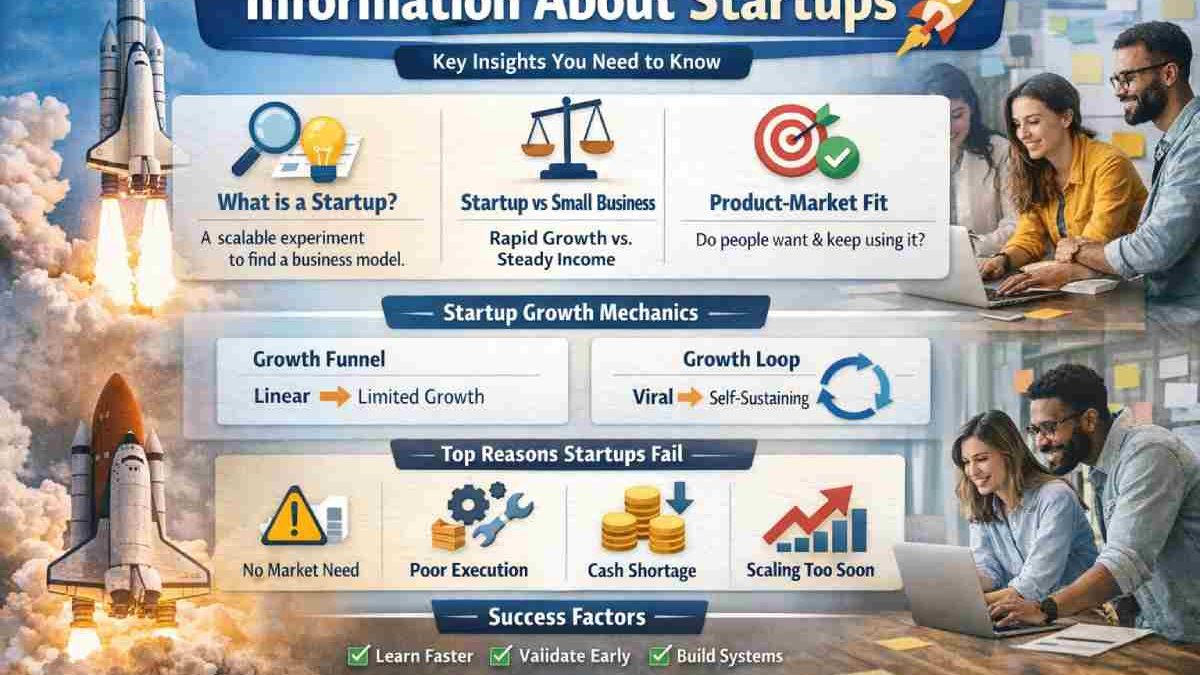
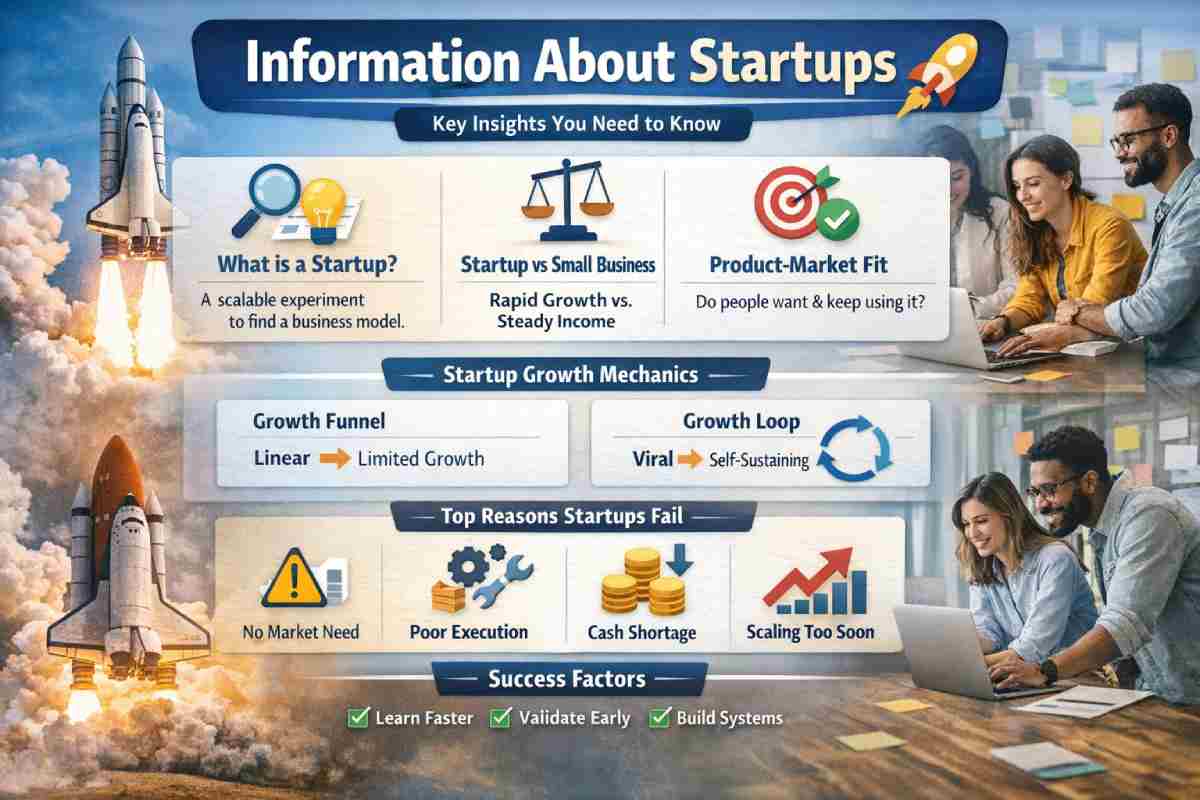
Almost all people are wrong about startups. What is startup is usually defined by everyone is a “new business”. But when it’s applied it will make bad choices – scale prematurely, raise money without any validation and product, build what nobody asks for, …etc. In reality, its “simple” and down to earth.
Startup is a system for testing, learning and building-rebuilding a business model in uncertainty.
In this guide we’re going to define startups as investors, founders, and organizations such as the Harvard Business School, the Stanford Business School define it: Experiments- not guesses.
This article belongs to How to Start
Table of Contents
What Is a Startup?
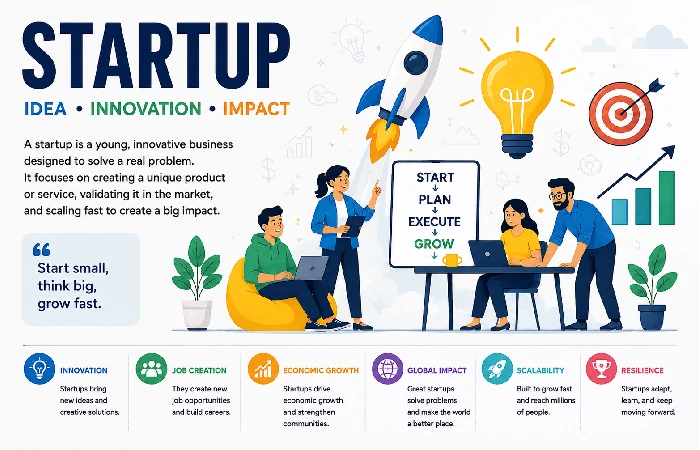
A startup isn’t a function of age and size. Rather, it’s a function of ambiguity and scalability.
In practice, a startup is:
- Searching for a business model
- Testing assumptions
- Trying to scale quickly once validated
For a broader overview of the startup concept and how startups are structured, see this guide to understanding startups.
Startup vs Small Business
| Factor | Startup | Small Business |
| Goal | Rapid scaling | Stable income |
| Model | Unproven | Proven |
| Risk | Very high | Moderate |
| Innovation | Core focus | Optional |
| Funding | External often | Self-funded |
| Growth Pattern | Exponential | Linear |
| Exit Strategy | Expected | Rare |
The Startup System: How Startups Actually Work
Startups operate as learning systems. The idea for their product is only a step on their journey in learning what works, what doesn’t.
The Validated Learning Loop
| Stage | Action | Outcome |
| Build | Create MVP | Test idea quickly |
| Measure | Track usage | Understand behaviour |
| Learn | Analyse results | Identify improvements |
| Iterate | Adjust product | Move closer to fit |
This loop is strongly emphasized by startup accelerators (Y Combinator) and research centres (MIT Entrepreneurship Centre).
For additional guidance on building and growing a startup, founders can explore Y Combinator’s startup advice.
Product-Market Fit (PMF) Explained
Product market fit = product meeting huge market need.
PMF Indicators
| Indicator | Meaning |
| High retention | Users keep coming back |
| Organic growth | Word-of-mouth expansion |
| Customer demand | Users actively seek product |
| Revenue consistency | Willingness to pay |
PMF Checklist
| Question | Yes/No |
| Do users return without reminders? | |
| Do customers recommend your product? | |
| Is there a clear pain point solved? | |
| Are users willing to pay? |
If most answers are “No,” you don’t have PMF yet.
Example Scenario (Illustrative)
| Metric | Before Improvement | After Improvement |
| Users | 1,000 | 1,000 |
| Active users | 100 | 500 |
| Paying users | 10 | 100 |
| Retention | Low | High |
Insight:
Growth only works after improving retention and demand.
Startup Growth Mechanics (What Most Guides Ignore)
Most beginner guides talk about “marketing,” but real startup growth is about systems.
A startup’s marketing approach can evolve as the company moves from validation to growth, making a clear startup marketing strategy important for sustainable customer acquisition
Growth Funnels vs Growth Loops
| Feature | Funnel | Loop |
| Flow | Linear | Circular |
| Growth | Stops without input | Self-sustaining |
| Example | Ads → Sales | User referrals |
| Efficiency | Decreases over time | Improves over time |
Growth Channels Overview
| Channel | Best Use Case |
| SEO/Content | Long-term growth |
| Paid Ads | Quick testing |
| Referrals | Viral growth |
| Partnerships | Market expansion |
Scaling Challenges
| Challenge | Explanation |
| Infrastructure issues | Systems break under load |
| Hiring mistakes | Wrong team composition |
| Customer support overload | Demand spikes |
| Operational complexity | Harder coordination |
Scaling requires planning—not just growth.
Types of Startups (Strategic Perspective)
Startup Categories
| Type | Description | Best For |
| Tech Startup | Software-based | Innovation |
| Scalable Startup | VC-backed | Rapid growth |
| Lifestyle Startup | Personal income | Flexibility |
| Social Startup | Impact-driven | Social change |
| Corporate Startup | Internal innovation | Large firms |
Choosing the Right Startup Type
| Goal | Recommended Type |
| Fast scaling | Scalable startup |
| Stable income | Small business |
| Social impact | Social startup |
| Freedom | Startup about lifestyle |
Once you have identified the right type of startup, understanding how to start a start-up can help turn the initial concept into a structured plan.
Startup Lifecycle (Stage-by-Stage)
Overview of the lifecycle:
| Stage | Focus | Risk Level |
| Idea | Validation | Very high |
| Pre-seed | MVP | High |
| Seed | Testing | High |
| Growth | Scaling | Medium |
| Expansion | Market reach | Medium |
| Exit | Monetization | Low |
Common Mistakes by Stage
| Stage | Mistake |
| Idea | Skipping validation |
| Seed | Overbuilding product |
| Growth | Scaling too early |
| Expansion | Losing focus |
Startup Business Models Explained
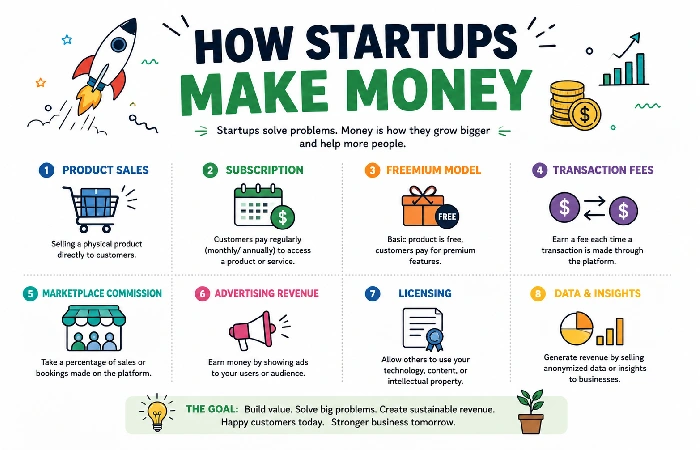
Core Business Models
| Model | Description | Example Use |
| Subscription | Recurring payments | SaaS |
| Freemium | Free + paid upgrades | Apps |
| Marketplace | Buyer-seller platform | E-commerce |
| Ads | Monetize traffic | Media |
| Transaction | Fee per transaction | Payment apps |
Choosing the Right Model
| Factor | Consideration |
| Product type | Digital vs physical |
| User behaviour | Frequent vs occasional |
| Revenue goal | Recurring vs one-time |
Startup Funding: Reality Check
Funding Foundations
| Type | Stage | Pros | Cons |
| Bootstrapping | Early | Control | Limited capital |
| Angel investors | Seed | Mentorship | Equity loss |
| Venture capital | Growth | Large funding | High pressure |
| Crowdfunding | Any | Public support | Uncertain |
Do You Need Funding?
| Situation | Funding Needed? |
| MVP testing | No |
| Product scaling | Yes |
| Hiring team | Often |
| Marketing expansion | Sometimes |
Organizations like World Bank emphasize that funding supports growth—but does not guarantee success.
For founders moving beyond the initial idea, understanding the practical steps involved in starting up a com
pany can help connect funding decisions with broader business planning.
Why Startups Fail System-Level Analysis
Top Failure Causes
| Cause | Impact |
| No market need | Immediate failure |
| Poor execution | Slow decline |
| Cash shortage | Shutdown |
| Early scaling | Collapse |
Failure Pattern
| Step | Outcome |
| Build product | No validation |
| Launch | Low demand |
| Scale | High cost |
| Burn cash | Failure |
Prevention Checklist
| Action | Purpose |
| Validate idea | Reduce risk |
| Track metrics | Data-driven decisions |
| Focus on retention | Ensure demand |
| Delay scaling | Avoid waste |
Benefits of Startups
Pros vs Cons
| Pros | Cons |
| High growth potential | High risk |
| Independence | Financial uncertainty |
| Innovation freedom | Stress |
| Skill development | Long timelines |
Step-by-Step: How to Start a Startup
Startup Framework
| Step | Action | Outcome |
| 1 | Identify problem | Direction |
| 2 | Validate demand | Confidence |
| 3 | Build MVP | Test product |
| 4 | Gather feedback | Improve |
| 5 | Launch | Market entry |
| 6 | Scale | Growth |
For founders ready to turn these steps into an organized business plan, this resource on planning for a start-up company provides another useful perspective.
Beginner Roadmap
- Start small
- Talk to users early
- Avoid perfection
- Focus on core value
Tools & Resources for Startups
| Category | Tools |
| Managing Project | Trello and Asana |
| Statement | Slack |
| Analytics | Google Analytics |
| Finance | QuickBooks |
| Development | GitHub |
Common Startup Myths
| Myth | Reality |
| Funding guarantees success | Many funded startups fail |
| Ideas matter most | Execution matters more |
| Growth is fast | Takes time |
| You need big money | Start small |
Future Trends in Startups (2026+)
Key Trends
| Trend | Impact |
| AI startups | Automation and efficiency |
| Remote work | Global teams |
| No-code tools | Faster development |
| Sustainability | Eco innovation |
| Creator economy | Individual-led startups |
Final Perspective
The ultimate startup beginner sin is caring about ideas instead of systems, because while a great idea can start something, it doesn’t scale: that’s what great systems do for startups. Startups with a system learn faster than the competition and get assumptions validated quickly instead of failing to build anything at scale, but have no idea if anyone wants it. In addition, they create organized processes instead of relying on hope and guesswork. As a result, they can continually test, iterate, and improve while reducing uncertainty and turning assumptions into concrete observations.
