
Last Updated: September 1, 2026
Video marketing delivers real business impact only when treated as a full-funnel growth system—where audience targeting, distribution, and measurement matter more than production alone.
Most organizations are already producing videos, yet many struggle to connect those efforts to leads, sales, or customer retention. That’s the core problem. Video is expensive, time-consuming, and highly visible—so ineffective campaigns waste both budget and credibility. The agitation intensifies when stakeholders ask, “What did we actually get from all those videos?”
Video marketing works when each video is designed for a specific business goal and buyer-journey stage, distributed intentionally, and evaluated using revenue-linked metrics—not views.
This guide provides a practical, strategy-first blueprint to plan, produce, distribute, and scale video marketing in 2026.
The article belongs to Content Marketing
Table of Contents
Why Most Video Marketing Fails
Many companies approach video as a creative project instead of a business system. They invest heavily in production but neglect targeting, messaging, and distribution.
Common failure patterns include creating awareness content when sales teams need qualified leads, spreading resources across too many platforms, and measuring success using vanity metrics.
Organizations highlighted by institutions such as the Content Marketing Institute and Harvard Business Review consistently show that marketing initiatives succeed when tightly aligned with business objectives.
Typical Failure vs Strategic Approach
| Aspect | Failing Approach | Strategic Approach |
| Goal | “Get more views” | Generate leads/sales |
| Topic selection | Trends or guesses | Customer pain points |
| Distribution | Post and hope | Planned amplification |
| Measurement | Views & likes | Pipeline & revenue |
| Timeline | One-off campaigns | Ongoing system |
What Video Marketing Strategy Actually Means
A true strategy integrates business goals, audience insights, messaging, and distribution into one coordinated plan.
Instead of asking “What video should we make?” successful teams ask:
- Who must we influence?
- What decision are they trying to make?
- What information reduces their risk?
- Where will they encounter this video?
Strategy Pillars
| Pillar | Key Question | Output |
| Audience | Who are we targeting? | Personas & segments |
| Message | What will persuade them? | Value proposition |
| Content | How will we communicate? | Video formats |
| Distribution | How will they see it? | Channel plan |
| Measurement | Did it work? | KPIs & ROI |
Why Video Dominates Digital Marketing in 2026
Video consumption continues to grow because it delivers information quickly while building emotional connection. It combines visual demonstration, storytelling, and human presence—elements that text alone cannot replicate.
Platforms such as YouTube, TikTok, Instagram, and LinkedIn now act as discovery engines where users actively search for solutions.
Why Audiences Prefer Video
| Factor | Why It Matters | Business Implication |
| Visual learning | Faster comprehension | Explainers perform well |
| Emotional cues | Builds trust | Testimonials effective |
| Mobile convenience | Anytime consumption | Short-form growth |
| Demonstration ability | Shows real use | Strong for products |
| Algorithm preference | Higher reach | Prioritize video formats |
Research organizations like Pew Research Center consistently report increasing video consumption across demographics.
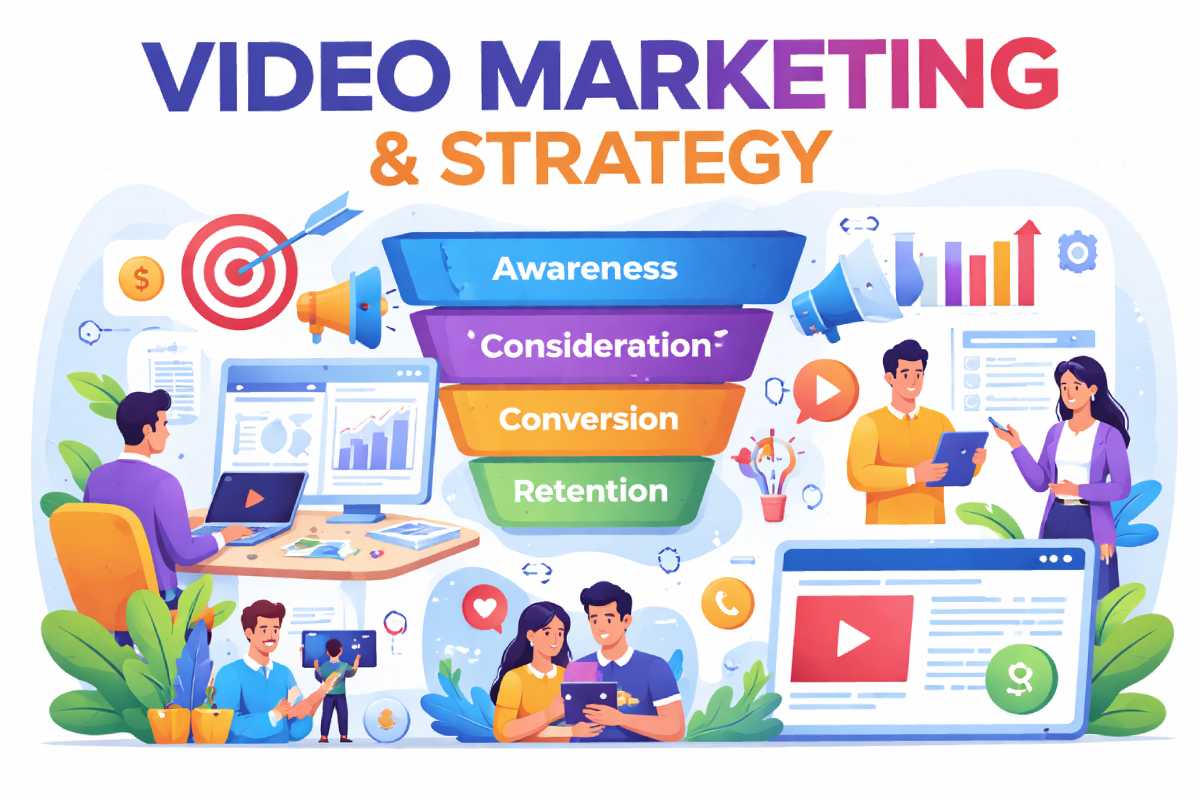
The Full-Funnel Video Framework
High-ROI strategies align videos to the customer journey rather than producing generic content.
Funnel Stage Mapping
| Funnel Stage | Audience Mindset | Effective Video Types | Primary Goal |
| Awareness | “I have a problem” | Educational, entertaining | Reach |
| Consideration | “What are my options?” | Explainers, webinars | Trust |
| Decision | “Which should I choose?” | Demos, testimonials | Conversion |
| Retention | “How do I succeed?” | Onboarding, tutorials | Loyalty |
Retention marketing often yields higher ROI than acquisition, a point emphasized by research from McKinsey & Company.
Audience Research for High-Impact Video
Effective video begins with understanding motivations, not demographics alone. Two people with similar age and income may have completely different buying triggers.
Audience Insight Framework
| Dimension | Questions to Ask | Why It Matters |
| Pain points | What frustrates them? | Drives attention |
| Desired outcomes | What success looks like | Shapes messaging |
| Barriers | What stops them buying? | Guides proof content |
| Decision process | Who influences purchase? | Affects targeting |
| Budget sensitivity | Price tolerance | Positions offers |
Platform-Specific Strategy
Each platform has unique user intent and content norms. Trying to dominate everywhere simultaneously usually dilutes impact.
Platform Comparison
| Platform | Strength | Best For | Weakness |
| YouTube | Search & long-form | Tutorials, education | Slower traction |
| TikTok/Reels | Rapid discovery | Awareness | Low buying intent |
| Professional trust | B2B leads | Smaller reach | |
| Website | Conversion | Sales content | Needs traffic |
Focus on one primary channel supported by secondary distribution.
Planning Videos That Convert
Conversion starts with clarity. Viewers must quickly understand the value of watching.
High-Conversion Structure
| Step | Purpose | Example |
| Hook | Capture attention | “Most ads waste money—here’s why.” |
| Problem | Create relevance | Highlight pain point |
| Solution | Present offer | Show method/product |
| Proof | Reduce risk | Case study/testimonial |
| CTA | Prompt action | “Start free trial” |
Production Strategy Without Overspending
High production value helps credibility but does not guarantee performance. Authentic, informative content often outperforms polished but generic videos.
Production Options
| Approach | Typical Cost (USD) | Best For | Trade-Off |
| DIY | $0–$1,000 | Testing ideas | Lower polish |
| Freelancer | $1,000–$10,000 | SMEs | Variable quality |
| Agency | $10,000–$100,000+ | Large campaigns | High cost |
Distribution — Where ROI Is Won or Lost
Content without reach produces no results. Distribution planning should receive as much attention as production.
Distribution Channels
| Channel | Speed | Cost | Control | Notes |
| Organic social | Slow–medium | Low | Low | Algorithm dependent |
| Paid ads | Fast | Medium–high | High | Precise targeting |
| Medium | Low | High | Warm audience | |
| Influencers | Medium | Medium | Medium | Trust transfer |
| Partnerships | Medium | Low–medium | Medium | Audience sharing |
Repurposing Strategy
One long video can generate:
| Asset | Use Case |
| Short clips | Social media |
| Blog article | SEO |
| Email content | Nurturing |
| Sales deck | Presentations |
| Podcast | Audio channels |
(Here we should link to a deeper guide on content repurposing.)
Budgeting and Cost Planning
Budgets vary widely depending on goals and geography.
Production Cost by Quality Tier
| Tier | Typical Budget | Characteristics | Suitable For |
| Basic | $500–$3,000 | Simple setup | Startups |
| Professional | $3,000–$25,000 | Crew & editing | SMEs |
| Premium | $25,000–$250,000+ | Cinematic | Enterprises |
Video Marketing Services Pricing Global
| Service Type | Typical Price Range | What’s Included |
| Strategy consulting | $1,000–$10,000 | Research & planning |
| Explainer video | $2,000–$20,000 | Script + animation |
| Ad video production | $3,000–$50,000 | Concept to delivery |
| Corporate video | $5,000–$100,000 | On-site filming |
| Ongoing content | $2,000–$30,000/month | Regular production |
Prices vary based on complexity, talent, and market rates.
Country-Wise Pricing & Locations
| Country/Region | Cost Level | Strengths | Typical Use Case |
| United States | Very high | Premium quality | Global campaigns |
| United Kingdom | High | Creative storytelling | Brand videos |
| Canada | High | Corporate production | B2B content |
| Australia | High | Advertising expertise | Commercials |
| India | Low–medium | Cost efficiency | Outsourced production |
| Philippines | Low | Editing & animation | Post-production |
| Eastern Europe | Medium | Technical skills | Animation/VFX |
Measuring ROI and Performance
Views indicate exposure, not success. Real impact comes from behavioral metrics.
Meaningful Metrics
| Metric | What It Shows | When Useful |
| Watch time | Engagement depth | Awareness stage |
| CTR | Interest | Consideration |
| Leads generated | Intent | Mid-funnel |
| Sales | Revenue impact | Bottom funnel |
| Customer retention | Loyalty | Post-purchase |
Organizations such as Gartner recommend multi-touch attribution because customers interact with multiple channels before converting.
Optimization and Scaling
Effective programs rely on continuous improvement rather than one perfect video.
Optimization Levers
| Element | What to Test | Potential Impact |
| Hook | First 3–5 seconds | Retention |
| Thumbnail | Visual appeal | Click rate |
| Length | Short vs long | Engagement |
| CTA | Placement & wording | Conversions |
| Audience targeting | Segments | Efficiency |
Scaling should occur only after consistent performance is validated.
Common Mistakes to Avoid
| Mistake | Consequence | Prevention |
| No strategy | Random results | Define goals first |
| Ignoring distribution | Low reach | Plan promotion |
| Overproduction early | Wasted budget | Validate ideas first |
| Wrong KPIs | Misleading success | Track revenue metrics |
| Inconsistency | No momentum | Commit long-term |
Future Trends in Video Marketing
Emerging developments will reshape strategy:
| Trend | Impact | Preparation |
| AI-generated video | Lower costs | Focus on ideas |
| Personalization | Higher relevance | Use data insights |
| Interactive video | More engagement | Invest in tools |
| Shoppable video | Direct sales | Integrate e-commerce |
| Owned audiences | Stability | Build email lists |
30-Day Video Strategy Launch Plan
| Week | Focus | Key Actions |
| Week 1 | Research | Define goals & audience |
| Week 2 | Planning | Topics & scripts |
| Week 3 | Production | Film & edit |
| Week 4 | Launch | Publish & measure |
Meaningful ROI typically emerges after several months of iteration.
Who This Strategy Is For and Not For
Best suited for:
- Businesses seeking measurable growth
- Marketing teams building repeatable systems
- Founders investing in long-term brand equity
Less suitable for:
- Those chasing viral fame
- Organizations unwilling to measure ROI
- Projects without clear objectives
Conclusion
Video marketing is powerful only when guided by strategy. When aligned with business goals, audience needs, and deliberate distribution, it becomes a predictable driver of awareness, trust, and revenue.
In an attention-scarce digital world, organizations that treat video as infrastructure—not just content—will consistently outperform competitors who simply publish and hope.
