


Starting an online business succeeds or fails based on choosing the right business model—not the platform, logo, or tools. This guide helps beginners pick a model aligned with skills, budget, and risk, then execute with clarity.
If you’re searching “start your online business,” you’re likely asking one simple but critical question: what should I actually do first so this works?
The problem is that most advice jumps straight into websites, tools, and branding, while skipping the most important decision—the business model. That leads to weeks of setup, no revenue, and the belief that online businesses don’t work.
They do work—but only when expectations match reality.
The solution is a model-first, reality-first approach: decide how money will realistically flow, how long it may take, and what risks you’re accepting before you build anything.
Table of Contents
Key Takeaways
- Your business model matters more than tools or platforms
- Beginners should prioritize speed to first revenue
- Most failures come from wrong expectations, not effort
- Validation must happen before branding or building
- There is no “best” online business—only the right fit
Why Most “Start an Online Business” Advice Fails
Most guides follow this pattern:
- Pick an idea
- Build a website
- Choose tools
- Monetize later
This assumes you have time, patience, and spare money. Most beginners don’t.
The real issue is misalignment between:
- Available time
- Budget
- Skills
- Risk tolerance
When these don’t match the business model, effort leaks instead of compounding.
The 5 Core Online Business Models (What Actually Exists)
Almost every beginner business falls into one of these five categories.
1. Service-Based Businesses (Freelancing, Consulting)
You sell your skills directly to clients.
Reality
- Fastest route to income
- Lowest startup cost
- Limited scale without systems
Illustrative example:
A beginner offering basic website setup or content writing can land paying clients within weeks—without ads or a personal brand.
2. Content + Monetization (Blog, YouTube, Newsletter)
You create content and monetize through ads, affiliates, or products.
Reality
- Slow revenue curve
- High competition
- Strong long-term upside
Creator-economy reports and Google Search Central guidance consistently show content businesses compound slowly and reward consistency, not urgency.
3. E-commerce (Physical & Digital Products)
You sell products via your site or platforms.
Reality
- Medium upfront cost
- Logistics and refunds matter
- Validation is critical
Digital products reduce risk. Physical products add shipping, inventory, and tax complexity.
4. Marketplaces & Platforms (Amazon, Etsy, Fiverr)
You sell inside an existing platform.
Reality
- Built-in demand
- Faster feedback
- Platform-rule dependency
Excellent for testing demand, weaker for long-term control.
5. SaaS / Tools
You build software and charge subscriptions.
Reality
- High leverage
- High technical and financial risk
- Slow validation
Despite the hype, SaaS is usually a poor first business unless you already have expertise or distribution.
Reality-First Comparison: Models, Cost, Risk & Speed
Business Model Comparison Table
| Model | Time to First Sale | Startup Cost | Monthly Cost | Risk | Scalability |
| Services | Fast | $0–$300 | Low | Low | Medium |
| Content | Slow | $50–$500 | Low | Medium | High |
| E-commerce | Medium | $300–$3,000 | Medium | Medium | High |
| Marketplaces | Fast | $0–$200 | Low | Medium | Medium |
| SaaS | Slow | $1,000+ | High | High | Very High |
Costs shown are illustrative ranges, not guarantees.
Aggregated Reviews & Founder Sentiment (What People Actually Experience)
Across founder communities, creator surveys, and small-business reports:
- Services & marketplaces show faster confidence and lower early burnout
- Content businesses show the highest quit rates due to slow feedback
- E-commerce failures often stem from poor validation, not marketing
- SaaS burnout is linked to long build cycles without user feedback
This pattern is consistent across regions and platforms.
Choose the Right Model for You
Ask yourself:
- How many hours per week can I commit consistently?
- Can I wait months before earning?
- Do I prefer selling directly or building systems?
Example Paths
- Students: services or marketplaces
- Working professionals: consulting or freelancing
- Creators: content, with realistic timelines
There’s no prestige in choosing the hardest model first.
Validate Before You Build Anything
Validation means real proof of demand, not opinions.
Validation Methods by Model
| Model | Validation Method |
| Services | Pre-selling, outreach |
| Content | Test content + engagement |
| E-commerce | Marketplace listing |
| Marketplaces | Demand + conversion |
| SaaS | Paid pilots, waitlists |
Research cited by Harvard Business Review consistently shows early validation reduces failure more than detailed planning.
Tools & Setup (Only After Validation)
Tools support businesses—they don’t create them.
Typical Tool Categories
- Website or storefront
- Payment processing
- Communication & delivery
Geographical Cost Differences
| Region | Typical Cost Level | Notes |
| US | Medium–High | Higher software & ad costs |
| UK | Medium | VAT considerations |
| EU | Medium | GDPR affects data & email |
| India | Low | Marketplaces & services common |
This is informational, not legal advice.
Timelines, Risk & Expectation Management
Illustrative Trend: Time vs Revenue Potential
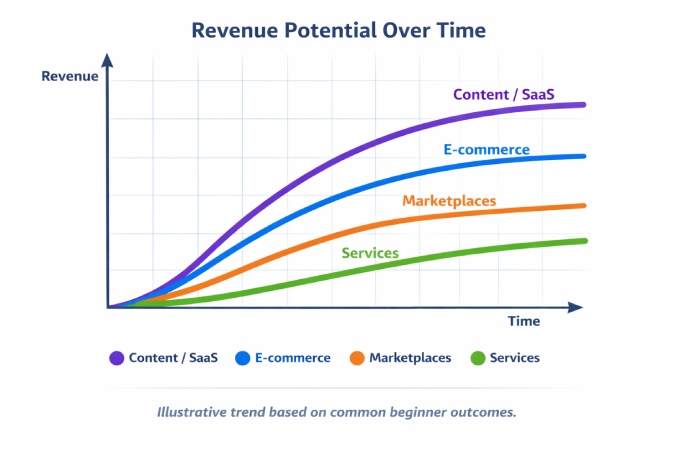
Key reality:
- Revenue often takes months
- First versions are usually wrong
- Distribution is harder than creation
Most people quit just before feedback arrives.
Common Beginner Mistakes That Kill Businesses
- Building before validating
- Copying saturated ideas
- Ignoring customer acquisition
- Expecting passive income early
These mistakes repeat across nearly every failed beginner story.
Scaling After Your First Revenue
Only scale after proof:
- Automate repeat tasks
- Delegate delivery
- Reinforce what’s already working
Scaling before revenue is fantasy. Scaling after validation is strategy.
Final Decision Framework: What Should You Do Next?
- Choose one model
- Validate demand quickly
- Earn first revenue
- Improve, then expand
No hacks. No hype. Just aligned decisions.