
Last Updated: August 28, 2026
Company formation isn’t a matter of a genius idea, but of risk reduction via testing for demand, producing something that people will pay money for, organization design, and appropriate scaling.
Starting up a company felt enormous. Advice ranges from “follow your passion” to complicated legal checklists. The process is straightforward: find a problem, prove customers will pay, and build around what you learn.
Table of Contents
What “Start-up of a Company” Really Means
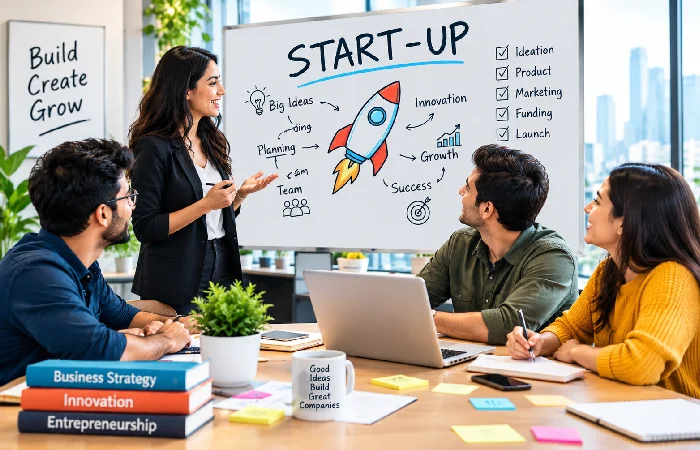
Not every new business is a startup. A startup is designed for repeatable, scalable growth.
A startup is usually built to grow beyond the founder’s direct involvement.
| Factor | Startup | Traditional Small Business |
| Growth aim | Rapid and scalable | Stable and local |
| Model | Repeatable systems | Often service-based |
| Funding | Equity or reinvestment | Savings or loans |
| Risk level | High uncertainty | Relatively lower |
This difference helps you choose the right path. A small business may suit those seeking steady income, while a startup suits significant growth.
Stage 1 — Find a Problem Worth Solving
The companies that win do so because they started as someone’s problem that drained their time, money or sanity.
For example, clinics may lose revenue because patients miss appointments. If clinics want to reduce no-shows and will pay for a solution, there is an opportunity.
Ask:
- What problem are customers facing?
- How do they solve it?
- Are they paying for alternatives?
- Is the problem important?
Spreadsheets, manual processes, and costly workarounds can signal unmet needs.
Stage 2 — Validate Demand Before Building
Validation separates an idea from a potential business. The question is: will customers pay?
People may like an idea but behave differently when money is involved. Real actions matter more than opinions.
| Validation Method | Insight Gained | Investment Needed |
| Simple offer page | Level of interest | Very low |
| Pre-sales | Willingness to pay | Low |
| Manual delivery | Real usage | Moderate |
| Pilot project | Practical feasibility | Moderate |
You can test demand without a complete product. If customers pay, return, and recommend a manually delivered service, the evidence is strong.
Stage 3 — Build a Sustainable Business Model
For a company it is necessary to devise a business model which allows sufficient returns for the support and growth.
Some common models consist of subscriptions, transaction fees, licensing, and direct sales.
| Model | Strength | Typical Risk |
| Subscription | Predictable income | Requires retention |
| Transaction | Scales with activity | Depends on volume |
| Freemium | Encourages adoption | Low conversion |
| Direct sales | High margins | Slower scaling |
A high customer acquisition cost can lead to accelerated growth translating to growing losses.
Stage 4 — Create a Minimum Viable Product
Minimum Viable Product (MVP) – the smallest thing you can build that will solve the core customer problem An MVP can be an app, a service, a prototype.
Build in short repetitions: build it release it learn, then repeat. Avoid wasting effort by learn quickly and often.
Stage 5 — Choose the Right Legal Structure
Select a structure to be accountable, pay taxes, own and get financed once the business is off the ground.
| Structure | Liability | Complexity | Investor Appeal |
| Sole proprietorship | Unlimited | Low | Minimal |
| Partnership | Shared | Low | Limited |
| LLC / Private Limited | Limited | Moderate | Strong |
| Corporation | Limited | High | Very strong |
Requirements change from country to country, ranging from India, America and the UK. Professional help can be acquired.
Stage 6 — Decide How to Fund the Venture
For founders, this may be a self-funding opportunity or a potential for funding via investors and/or loans in further stages of development.
| Funding Source | Best Stage | Main Trade-off |
| Personal funds | Idea to MVP | Limited scale |
| Friends and family | Early | Relationship risk |
| Angel investors | Early traction | Equity dilution |
| Venture capital | Scaling | Less control |
| Bank loans | Revenue stage | Repayment obligation |
Bootstrapping provides control but may limit growth. Investors provide capital but expect equity. Loans give continued ownership but require the money to be paid back.
Funding should support a promising business, not replace validation.
Stage 7 — Build an Effective Early Team
Early employees influence culture and speed. It’s good that many people with multi-responsibilities and different talents can come to your help.
Don’t Hire So Fast. You burn your runway with salary expenses before you know youve earned money. Flexibility comes from using fewer people.
Stage 8 — Develop a Go-to-Market Strategy
Of course, a good product won’t get you a customer in and of itself. You need a plan to get customers.
Early stage, startups will frequently use methods like direct outreach, alliances, paid advertising, and content marketing.
| Channel | Speed of Results | Long-Term Potential |
| Direct sales | Moderate | High for B2B |
| Paid advertising | Fast | Moderate |
| Content marketing | Slow | High |
| Corporations | Modest | High |
Sales conversations demonstrate what customers are looking for. These also shed light on the reasons why customers are buying.
Stage 9 — Achieve Product-Market Fit Before Scaling
Product-market fit means using, buying, and telling others about your product. Key indicators of success include retention, replay, referrals and inbound customer interest.
Until this point, do not engage in aggressive recruiting, further geographic growth or increased advertising spending.
Scaling a weak model can magnify problems.
Scale the things that are going to make you succeed, not the things that you want to make you succeed.
Common Mistakes That Derail New Companies
The issues many businesses encounter stem from over-building before checking demand, being oblivious about money, expanding at a rate too rapid to support or from issues like: confusion over responsibilities, conducting insufficient market research, lacking effective communication and wasting money.
Before investing, ask:
- Do we have paying customers?
- Do we understand our costs?
- Was the business model sustainable?
- Customers coming back / referring business?
- What evidence supports our next decision?
If unclear, more testing may be better than expansion.
Final Perspective
Launching your business wasn’t one action. It was a series of actions that progressively eliminated the unknowns.
Problem to address, demand-testing, minimal product, healthy unit economics, right structure, scale if vindicated. Entrepreneurship.
If entrepreneurs approach it as learning-experimenting and refining.
