
Table of Contents
Introdution
Marketing is one of the most critical moments of any business since it is what allows you to connect with customers, create relationships and transmit the message that will enable you to make sales and generate money.
For many people who start a business adventure on the Internet, it can be frustrating or unclear to know what to do or what steps need to be taken to start successfully and on the right track.
Without marketing, failure is the most likely destination.
Online Marketing Plan – 10 Steps to Start Successfully
If you already know the type of business you will create or are ready to start doing Internet marketing, follow this 10-step guide to starting on the right foot.
Then little by little, I recommend you improve and optimize each of these points; Remember that everything changes very quickly on the Internet, and it is necessary to adapt to current trends.
1. Define your business, your niche, brand, and products/services
Before making a marketing plan, it is important to have defined some aspects that are pillars of your Internet business; some of them are:
- Your business model. On the Internet, several types of business can be undertaken. What will be yours? It is essential to define it from the beginning. It can be creating and selling digital products, a virtual store of physical products, affiliate marketing, mobile applications, etc.
- Your market niche. Who are you going to direct all your marketing and products to? Defining the market niche through market research is an important step that will allow you to focus your marketing plan on the right people.
- Your brand. If you are going to do branding and create a brand, defining its identity and characteristics is necessary.
- Your products/services. Although it is not mandatory, you can already have defined the products or services that you are going to offer. As you get to know more about your market, it’s needs, problems, and motivations, you will be able to create better products and solutions.
All these elements are a previous step in creating your marketing plan.
Online Business Models, Cost & Geography
| Business Model | Startup Cost (Avg.) | Best Regions | Scalability |
|---|---|---|---|
| Affiliate Marketing | $50–$150 | Global | High |
| Digital Products | $100–$300 | North America, Europe | Very High |
| E-commerce | $300–$1,000 | US, UK, Asia | Medium–High |
| Online Services | $50–$200 | Local + Global | Medium |
2. Study your market in-depth (including competition)
The more you know your market, the better products you will be able to offer them, and your marketing will be engaged the right people. I study that this is a step always in constant study and progress. Meanwhile, you can always see a little more about any niche and the people that make it up.
It is also crucial to carry out a competition study. This works to find out what they are doing and offering (so you can provide something better or unique) and generate exciting ideas.
I do not mean to copy what they do directly, but if you find already successful businesses or people in your market, you can guide yourself and take them as a good reference.
To study the competition, you can use Google to look for keywords or terms related to your main topic, use social networks, go to forums or explore product markets such as Clickbank, eBay, JVZoo, Commission Junction, etc.
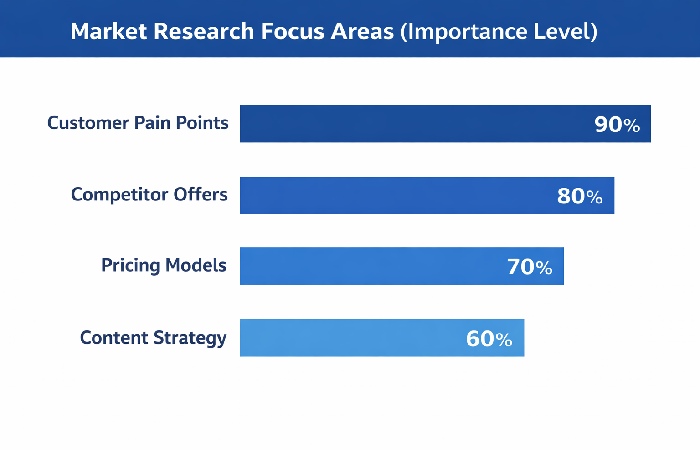
Market Research Focus Areas
 3. Usual your short and long term goals and objectives
When you reach this third step, you have already defined a business model, a niche or market, a brand (perhaps), and an idea or concept of the product you will sell.
You have also already done solid market research; you know well the needs of your prospects and future clients.
Before moving on to marketing strategies, it is essential to define your short-term and long-term goals. A plan is like a map that will take us to the destination (goals or objectives) that we want to reach.
You always have to make the goals realistic (not so pessimistic but not unrealistic either).
They can be about sales (how much you want to sell by a specific date), how many products to have available to sell, positioning, staff growth, etc.
The areas you set will depend on the type of business you will develop.
4. Create a unique selling proposition
What is going to make you different from the competition? What makes you unique in the market?
Therefore, every person and every business is different and has something unique to offer that no one else can. Unfortunately, however, not everyone takes the time and effort to develop a unique selling proposition.
While it is not mandatory, and you can start without it, I recommend creating it as soon as possible. Then, you can perfect it over time.
5. Define your traffic sources
One of the most critical columns of your online marketing plan will be the traffic sources to use. On the Internet, we have available many systems and strategies to generate traffic and visits to a Web page.
To choose correctly, it is essential to comply with the first step that we have previously seen since the traffic sources will depend mainly on the business model and market niche on which you are going to focus.
Traffic Sources, Cost & Regional Performance
| Traffic Source | Cost | Best Regions | Speed |
|---|---|---|---|
| SEO | Low | Global | Slow |
| Social Media | Low | Asia, Europe | Medium |
| Google Ads | High | US, UK, CA | Fast |
| Facebook Ads | Medium | Global | Fast |
6. Take content marketing into account
On the Internet, information is the main asset that is shared everywhere. As a result, more and more people and businesses choose a content marketing strategy as an essential part of building their business.
With content marketing, you can spot yourself as an expert, educate and teach, generate virality, influence, and create trust in your market. The benefits are unmatched, and little by little, it has become a necessity instead of something optional.
Create a WordPress blog and a blogging strategy to begin publishing articles and valuable information. Then use social networks, SEO, and other methods to attract readers.
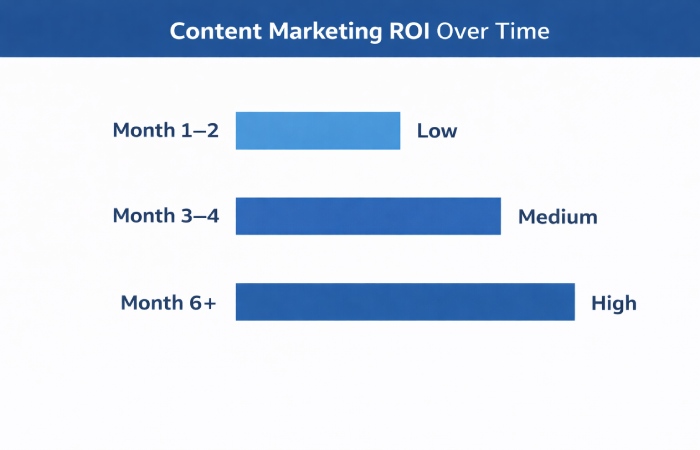
Content Marketing ROI Over Time
 7. Email marketing
Email marketing is always one of the essential pillars of (almost) every Internet marketing plan, regardless of the niche or the business model to be developed.
There will be somewhere it is used less or not as relevant, but email will never cease to be a piece with unique benefits that cannot be obtained elsewhere.
To put email marketing into practice, you will need an autoresponder (such as Mailchimp or Aweber) to “capture” prospects, send them messages and establish a long-term relationship of trust to convert them into customers later.
Email Marketing Tools & Monthly Cost
| Tool | Monthly Cost | Best For |
|---|---|---|
| Mailchimp | Free–$20 | Beginners |
| AWeber | $19–$29 | Automation |
| ConvertKit | $29–$49 | Creators |
| GetResponse | $15–$45 | Funnels |
8. Advertising
Within the primary traffic sources to define, it is essential to consider advertising. There are several ways to do marketing and generate free visits, such as social networks and SEO, but although these may not cost that much money, they are time-consuming and do not give immediate results.
Internet advertising allows you to start testing any business or market immediately, receiving visits, testing capture pages, and conversions in your sales letter.
The two options that I recommend the most for advertising are Google Adwords and Facebook Ads. Both are pay-per-click programs with different costs depending on the budget and the market niche.
You can also advertise on other sites or blogs on topics related to yours that allow you to put a banner or text. A monthly fee is usually charge to use this method.
Although not required, advertising can significantly accelerate your marketing and growth.
9. Necessary tools
In addition to a hosting account, a domain, and a website, other types of tools may be needed to optimize, measure, and sell successfully on the Internet.
Here is a list of examples to consider:
- Software de email marketing (autoresponder).
- WordPress-specific plugins.
- Software to measure conversions does split tests and analytics.
- Cloud file hosting service
- Software to do market and competition research
- Updates on the server or more domains
- Professional themes or templates
- Plugins to create memberships
- Payment processors like PayPal, e-Junkie, Click bank, etc.
- Others more
Essential Marketing Tools & Costs
| Tool Category | Example | Monthly Cost |
|---|---|---|
| Hosting & Domain | Bluehost | $10–$20 |
| Email Software | Mailchimp | $0–$30 |
| Analytics | Google Analytics | Free |
| Design Tools | Canva | $0–$12 |
| Payment Processors | PayPal | Transaction-based |
Each of these tools fulfills a function that helps your marketing plan work successfully and meet the established objectives.
It is significant to consider them in the budget because each implies an expense. However, not all of them may be need.
10. Sales Funnel
A sales funnel converts visitors into long-term customers through automation.
Typical Funnel Flow:
-
Traffic → Landing page
-
Email sequence (5–7 days)
-
Low-ticket product ($20–$30)
-
Upsell ($100–$300)
-
Long-term customer relationship
Graph 3: Conversion Funnel 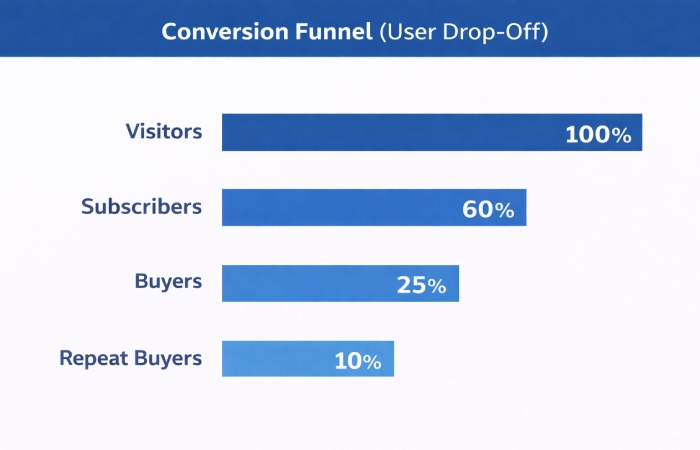
Conclusion
Marketing is one of the most critical moments of any business since it is what allows you to connect with customers, create relationships and transmit the message that will enable you to make sales and generate money. If you have any comments to contribute, we will be happy to hear them. Please share this article or tell us on social networks; we regularly update tips on Work Publishing. Please keep supporting us.