
Last Updated: August 31, 2026
Table of Contents
Introduction
Finance and the financial system are fundamental pillars of modern economies. Every financial activity—saving money, investing in stocks, borrowing for a home, or paying digitally—exists within a structured financial system that connects individuals, businesses, governments, and global markets.
In simple terms, finance refers to the management and movement of money, while the financial system is the framework that enables this movement. For a broader introduction to the subject, understanding what finances are can help beginners understand how money is managed and used in everyday life. This framework includes banks, financial markets, payment networks, financial instruments, regulatory institutions, and technological infrastructure.
For beginners, finance can seem abstract and technical. Yet when examined through the lens of how money moves through the economy, the concept becomes far easier to understand. Savings become investments, investments fund businesses, businesses generate economic activity, and that activity feeds back into the financial system.
This article explains finance and the financial system from both a foundational and practical perspective. You will learn the key components of financial systems, how financial institutions operate, how capital flows across markets, and how modern technologies such as fintech and digital currencies are reshaping global finance.
This article belongs to Business Finance
What Is Finance?
Finance is the study and practice of managing money, assets, investments, and financial risks. It involves making decisions about how funds are obtained, allocated, and utilized over time.
Core Concept of Finance
| Element | Explanation |
|---|---|
| Definition | Finance is the management, creation, and study of money and investments |
| Main Purpose | Allocate financial resources efficiently |
| Key Participants | Individuals, corporations, governments, financial institutions |
| Core Activities | Saving, investing, borrowing, lending, budgeting, and risk management |
| Economic Role | Supports economic growth and wealth creation |
Finance exists because resources are limited while financial needs are continuous. Efficient financial systems help distribute capital to areas where it can produce the greatest economic value.
Main Types of Finance
Finance can be divided into several branches depending on who manages the money and how it is used.
Branches of Finance
| Type of Finance | Description | Common Examples |
|---|---|---|
| Personal Finance | Financial planning and money management for individuals | budgeting, retirement planning |
| Corporate Finance | Financial management within businesses | capital investment, mergers |
| Public Finance | Government management of revenue and spending | taxation, infrastructure funding |
| Behavioral Finance | Study of psychological factors influencing financial decisions | investor sentiment |
| International Finance | Financial transactions across national borders | foreign exchange markets |
Personal finance focuses on individuals managing their income, expenses, and savings. Corporate finance focuses on how companies fund operations and growth. Public finance examines government spending and taxation policies.
Managing household money effectively is another important part of personal finance, and family finances can provide additional context on how financial decisions affect households.
What Is the Financial System?
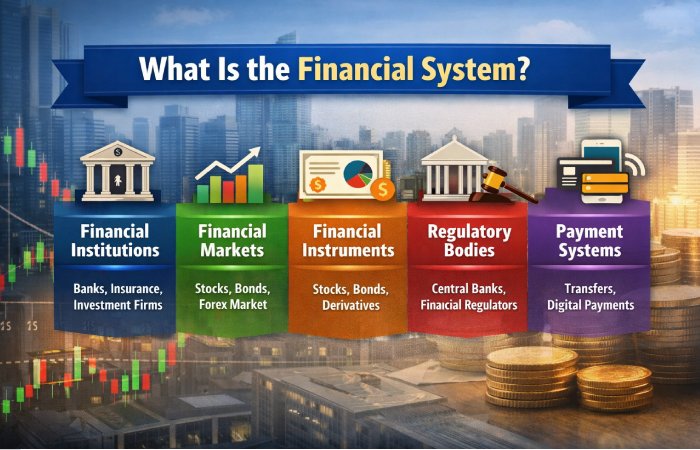
The financial system is the network of institutions, markets, instruments, and regulations that facilitate financial transactions.
It enables the transfer of funds between savers and borrowers and ensures that capital flows efficiently through the economy.
Structure of the Financial System
| Component | Role |
|---|---|
| Financial Institutions | Provide banking and financial services |
| Financial Markets | Platforms where financial assets are traded |
| Financial Instruments | Assets that represent financial value |
| Regulators | Maintain financial stability and oversight |
| Payment Systems | Enable transactions and fund transfers |
Without a financial system, economic growth would slow dramatically because businesses would struggle to obtain funding and individuals would have limited investment opportunities.
Key Components of the Financial System
Financial Institutions
Financial institutions act as intermediaries between savers and borrowers.
| Institution | Function | Example Services |
|---|---|---|
| Commercial Banks | Accept deposits and provide loans | savings accounts, mortgages |
| Investment Banks | Help companies raise capital | IPOs, mergers |
| Insurance Companies | Provide financial protection against risks | life and health insurance |
| Pension Funds | Manage retirement savings | retirement investment portfolios |
| Fintech Firms | Provide digital financial services | mobile payments, online lending |
Banks are often considered the central component because they facilitate both deposits and lending activities.
Financial Markets
Financial markets allow individuals and institutions to trade financial assets.
| Market Type | Description | Example |
|---|---|---|
| Stock Market | Trading of company shares | stock exchanges |
| Bond Market | Trading government and corporate debt | treasury bonds |
| Money Market | Short-term financial instruments | treasury bills |
| Derivatives Market | Contracts based on underlying assets | futures, options |
| Foreign Exchange Market | Currency trading | global forex market |
These markets provide liquidity and price discovery, allowing investors to buy and sell assets efficiently.
Financial Instruments
Financial instruments represent assets that can be traded or invested in.
| Instrument | Description | Risk Level |
|---|---|---|
| Stocks | Ownership shares in a company | High |
| Bonds | Loans made to governments or corporations | Medium |
| Mutual Funds | Pooled investments managed by professionals | Medium |
| ETFs | Exchange-traded diversified investment funds | Medium |
| Derivatives | Contracts based on asset values | High |
Each instrument carries different risk and return characteristics.
For a broader understanding of financial concepts, information about finances can also help explain how different financial activities and instruments fit into the wider financial landscape.
Functions of the Financial System
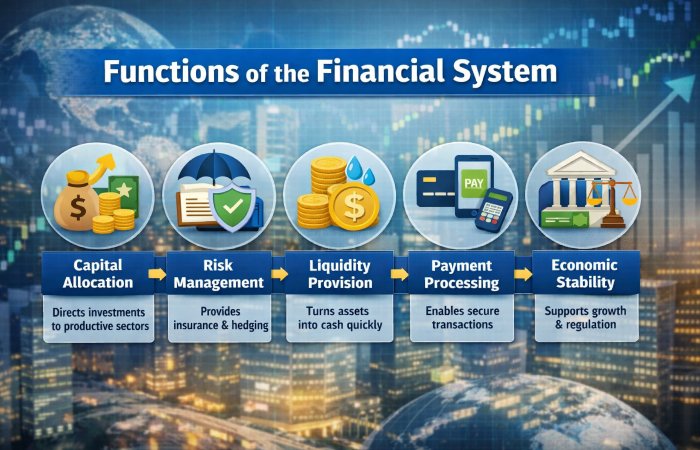
The financial system performs several essential roles that keep economies functioning smoothly.
Major Functions
| Function | Explanation |
|---|---|
| Capital Allocation | Directs savings toward productive investments |
| Risk Management | Provides tools such as insurance and derivatives |
| Liquidity Provision | Allows assets to be converted into cash quickly |
| Payment Processing | Facilitates transactions between individuals and businesses |
| Economic Stability | Supports monetary policy and financial regulation |
An efficient financial system ensures that capital flows to sectors that can generate economic growth.
How Money Flows Through the Financial System
Understanding the flow of money helps illustrate how the financial system connects various participants.
Simplified Financial Flow
| Stage | Activity |
|---|---|
| 1 | Individuals deposit savings in banks |
| 2 | Banks lend money to businesses |
| 3 | Businesses invest in production and expansion |
| 4 | Economic activity generates profits and employment |
| 5 | Investors and savers receive returns |
This cycle is fundamental to economic development because it transforms idle savings into productive investments.
Businesses can also become direct destinations for capital, making decisions about how to invest money in a business an important part of the broader financial flow.
Role of Central Banks
Central banks play a crucial role in maintaining financial stability and controlling monetary policy.
Key Responsibilities
| Tool | Purpose |
|---|---|
| Interest Rate Policy | Controls inflation and borrowing costs |
| Open Market Operations | Buying and selling government securities |
| Reserve Requirements | Regulates bank lending capacity |
| Liquidity Support | Stabilizes financial markets during crises |
Central banks also supervise commercial banks to ensure financial stability.
Financial Technology Transforming the System
Technology is rapidly transforming financial systems worldwide.
Fintech Innovations
| Technology | Impact on Finance |
|---|---|
| Mobile Payments | Faster and more accessible transactions |
| Blockchain | Secure decentralized record-keeping |
| Artificial Intelligence | Advanced risk analysis and fraud detection |
| Robo-Advisors | Automated investment management |
| Digital Banking | Branch-free financial services |
Fintech companies are increasingly competing with traditional banks by offering faster and more convenient services.
Risks Within the Financial System
Despite its benefits, the financial system also faces significant risks.
Major Financial Risks
| Risk Type | Description |
|---|---|
| Market Risk | Losses due to asset price changes |
| Credit Risk | Borrowers failing to repay loans |
| Liquidity Risk | Difficulty converting assets into cash |
| Systemic Risk | Collapse of large financial institutions affecting the entire system |
| Cyber Risk | Digital security threats |
Effective regulation and risk management are necessary to maintain financial stability.
Why the Financial System Matters for Economic Growth
A strong financial system accelerates economic development.
Economic Benefits
| Benefit | Explanation |
|---|---|
| Investment Expansion | Businesses gain access to funding |
| Job Creation | New businesses and industries emerge |
| Innovation | Funding supports research and technology |
| Infrastructure Development | Governments finance public projects |
Countries with well-developed financial systems tend to experience faster economic growth.
The Future of Finance and Financial Systems
Financial systems are evolving due to technological innovation and regulatory changes.
Emerging Trends
| Trend | Potential Impact |
|---|---|
| Central Bank Digital Currencies | Government-issued digital money |
| Artificial Intelligence in Finance | Smarter financial decision-making |
| Blockchain Infrastructure | Transparent financial transactions |
| Open Banking | Data sharing between financial institutions |
These innovations may reshape how financial services are delivered globally.
Conclusion
Finance and the financial system are essential mechanisms that drive modern economies. By connecting savers with borrowers, facilitating investment, and enabling secure transactions, the financial system ensures that capital flows efficiently across society.
Understanding its structure—financial institutions, markets, instruments, and regulators—helps individuals and businesses make informed financial decisions. As technology continues to transform global finance through fintech, digital currencies, and AI-driven analysis, the financial system will continue evolving to meet the demands of a rapidly changing economy.
