


Finances work best as a system, not isolated actions. When income, spending, saving, investing, and protection are aligned, financial outcomes become predictable and scalable.
Most people search for information about finances expecting definitions or quick tips. But what they actually need is a clear system to manage money effectively.
If you control how money flows in and out, build savings for stability, invest consistently for growth, and protect against risks, your financial life becomes structured and predictable.
The problem is that most people don’t operate with a system. They earn, spend, and occasionally save—but without coordination. This leads to stress, confusion, and slow progress.
The solution is simple but powerful: treat finances as a connected system, not isolated actions.
Table of Contents
What “Information About Finances” Actually Includes
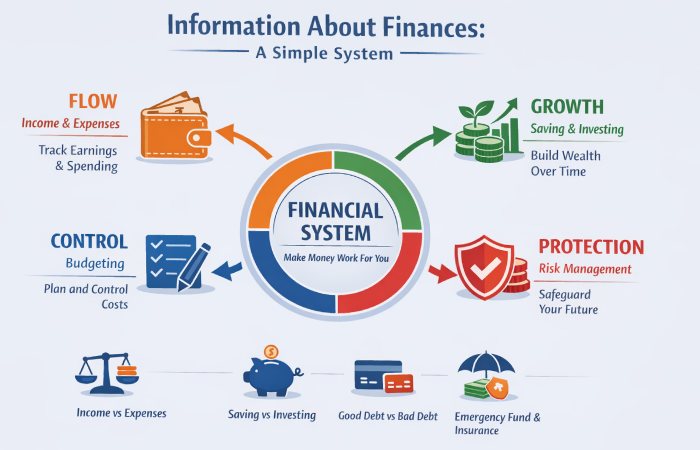
At its core, finances involve how you handle money across different stages of life. But in reality, it is broader than just managing income or saving money.
| Aspect | What It Means in Practice | Why It Matters |
|---|---|---|
| Income | Money earned from work or assets | Starting point of all finances |
| Expenses | Money spent on needs and wants | Determines savings potential |
| Saving | Money set aside for safety | Prevents financial shocks |
| Investing | Money used to generate returns | Builds long-term wealth |
| Protection | Risk management tools | Prevents financial collapse |
Insight:
Finances are not a one-time activity—they are a continuous process.
The Financial System Framework
To understand finances properly, you must see how each part connects.
Financial System Overview
| Component | Role | Outcome |
|---|---|---|
| Flow | Income and expenses | Cash movement |
| Control | Budgeting | Spending discipline |
| Growth | Saving and investing | Wealth creation |
| Protection | Insurance and reserves | Risk reduction |
Example: Monthly Financial Flow
| Category | Amount (₹) | Explanation |
|---|---|---|
| Income | 50,000 | Salary |
| Expenses | 35,000 | Living costs |
| Savings | 10,000 | Emergency + goals |
| Investments | 5,000 | Mutual funds / stocks |
This simple structure shows how money should be distributed.
Income vs Expenses – The Real Wealth Factor
Many people focus only on earning more, but ignore spending habits.
Comparison Scenario
| Factor | Person A | Person B |
|---|---|---|
| Income | ₹1,00,000 | ₹50,000 |
| Expenses | ₹95,000 | ₹30,000 |
| Savings | ₹5,000 | ₹20,000 |
| Financial Outcome | Slow growth | Faster wealth build |
Expense Breakdown
| Expense Type | Examples | Control Level |
|---|---|---|
| Fixed | Rent, EMI | Low |
| Variable | Food, transport | Medium |
| Discretionary | Entertainment, shopping | High |
Reducing discretionary expenses has the biggest impact.
Budgeting That Actually Works
Budgeting is often misunderstood as restriction. In reality, it is about control and clarity.
Popular Budgeting Methods
| Method | Structure | Best For |
|---|---|---|
| 50/30/20 Rule | Needs, wants, savings | Beginners |
| Zero-Based Budget | Assign every rupee a job | Full control seekers |
| Envelope System | Cash-based spending | Overspenders |
Budget Effectiveness Checklist
| Question | Yes/No |
|---|---|
| Do you track all expenses? | |
| Do you save monthly? | |
| Can you follow it consistently? |
If you answer “No” to most, simplify your budget.
Saving vs Investing – Understanding the Difference
Saving and investing are often confused but serve different purposes.
Comparison Table
| Factor | Saving | Investing |
|---|---|---|
| Purpose | Safety | Growth |
| Risk | Low | Medium to High |
| Time Horizon | Short-term | Long-term |
| Returns | Low | Higher potential |
Allocation Example
| Goal | Strategy | Tool Used |
|---|---|---|
| Emergency Fund | Saving | Bank account |
| Buying a phone | Saving | Short-term deposit |
| Retirement | Investing | Mutual funds/stocks |
Rule:
Always secure your base before chasing growth.
Investing Basics with Practical Insight
Investing is how money grows beyond inflation.
Asset Class Comparison
| Asset Type | Risk Level | Return Potential | Ideal Use Case |
|---|---|---|---|
| Stocks | High | High | Long-term growth |
| Mutual Funds | Medium | Moderate | Beginners |
| Bonds | Low | Stable | Capital protection |
| Real Estate | Medium | Moderate | Asset building |
Example: Monthly Investment
| Monthly Investment | Duration | Approx Outcome (Illustrative) |
|---|---|---|
| ₹5,000 | 10 years | Significant growth |
| ₹5,000 | 20 years | Much higher growth |
Institutions like the Reserve Bank of India and Securities and Exchange Board of India emphasize disciplined, long-term investing.
The Power of Compounding
Compounding is the most powerful force in finance.
Growth Example
| Year | Investment Value (₹10,000 @10%) |
|---|---|
| 1 | ₹11,000 |
| 5 | ₹16,105 |
| 10 | ₹25,937 |
Early vs Late Investing
| Investor Type | Start Age | Monthly Investment | Result |
|---|---|---|---|
| Early | 25 | ₹5,000 | Higher wealth |
| Late | 35 | ₹10,000 | Lower wealth |
Insight:
Time amplifies money.
Debt – Strategic Tool or Risk
Debt must be used carefully.
Debt Evaluation
| Question | Decision |
|---|---|
| Does it increase income? | Consider |
| Is interest high? | Avoid |
| Is it essential? | Evaluate |
Debt Types
| Type | Impact |
|---|---|
| Education Loan | Positive |
| Home Loan | Neutral |
| Credit Card Debt | Negative |
Behavioral Finance – The Real Game
Financial success is heavily influenced by behavior.
Common Biases
| Bias | Effect |
|---|---|
| Overconfidence | Risky decisions |
| Fear | Avoiding investments |
| Herd mentality | Following trends blindly |
Example Behavior Pattern
| Action | Result |
|---|---|
| Panic selling | Loss |
| Long-term holding | Growth |
Organizations like the International Monetary Fund highlight behavioral impact on financial systems.
Financial Lifecycle Strategy
Your financial approach should evolve.
Lifecycl
| Stage | Focus Area | Strategy |
|---|---|---|
| Early | Saving habits | Build discipline |
| Mid | Investing | Grow assets |
| Late | Protection | Preserve wealth |
Building Financial Resilience
Resilience ensures stability during uncertainty.
Resilience Checklist
| Element | Status |
|---|---|
| Emergency Fund | ✔ |
| Insurance | ✔ |
| Investments | ✔ |
Risk Protection
| Risk Type | Protection Tool |
|---|---|
| Medical | Health insurance |
| Job loss | Emergency fund |
| Market risk | Diversification |
Common Financial Mistakes
Mistake Analysis
| Mistake | Impact |
|---|---|
| No budget | Overspending |
| No investing | Lost growth |
| High debt | Financial stress |
| Delayed saving | Weak foundation |
Step-by-Step Financial System
Action Plan
| Step | Action | Outcome |
|---|---|---|
| 1 | Track expenses | Awareness |
| 2 | Budget | Control |
| 3 | Save | Stability |
| 4 | Reduce debt | Freedom |
| 5 | Invest | Growth |
| 6 | Protect | Security |
Conclusion
Financial success is not about luck or intelligence—it is about consistency. When you follow a structured financial system, you naturally reduce mistakes, build confidence in your decisions, and create long-term wealth over time. Instead of reacting to money problems, you begin to control outcomes. The goal is simple: make your money work for you, rather than constantly wondering where it went.