


Launching a product may seem like a single milestone, but in reality, it is a structured, multi-phase strategy that determines whether your idea becomes a market success or fades into obscurity. A successful product launch is not driven by luck—it is the result of deep research, strategic planning, cross-functional collaboration, and continuous optimization.
At its core, a product launch is about introducing a product or service to the market in a way that generates awareness, builds anticipation, and drives adoption. However, what separates successful launches from failed ones is how well companies execute across three critical stages: pre-launch, launch, and post-launch.
This guide breaks down each phase in detail, combining proven frameworks, practical steps, and structured tables to help you execute a high-impact launch.
Table of Contents
What is a Product Launch?
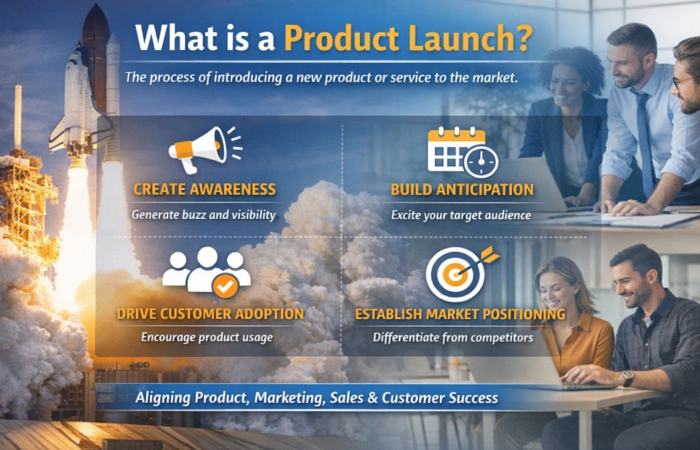
A product launch is the coordinated effort of bringing a new product to market. It involves aligning multiple departments—product, marketing, sales, and customer success—to ensure the product reaches the right audience with the right message at the right time.
The ultimate goal is to:
-
Create awareness
-
Build anticipation
-
Drive customer adoption
-
Establish market positioning
Key Characteristics of a Product Launch
| Element | Description | Impact |
|---|---|---|
| Market Introduction | Official release of product | First impression matters |
| Customer Awareness | Campaigns to inform audience | Drives reach and visibility |
| Positioning | Communicating value proposition | Differentiates from competitors |
| Cross-functional Collaboration | Multiple teams involved | Ensures smooth execution |
| Revenue Enablement | Sales readiness | Converts interest into sales |
What Is the Product Launch Process?
The product launch process refers to the structured steps companies follow to bring a product to market successfully. This process varies depending on industry, product complexity, and investment level, but the core framework remains consistent.
Product Launch Phases Overview
| Phase | Focus | Key Outcome |
|---|---|---|
| Pre-launch | Research & preparation | Market readiness |
| Launch | Execution & promotion | Visibility & adoption |
| Post-launch | Optimization & scaling | Growth & retention |
Core Product Launch Activities
These activities form the backbone of any launch strategy and must be executed with precision.
| Activity | Purpose | Outcome |
|---|---|---|
| Target Audience Segmentation | Identify ideal customers | Better targeting |
| Competitive Analysis | Understand competitors | Strong differentiation |
| Product Naming & Packaging | Build brand recall | Improved recognition |
| Messaging & Positioning | Communicate value clearly | Customer clarity |
| Sales Enablement | Equip sales teams | Higher conversions |
| Website & Landing Pages | Central information hub | Lead generation |
| Advertising & Promotion | Drive awareness | Increased traffic |
| PR & Media Outreach | Build credibility | Brand trust |
How to Pitch a Product Launch
A strong product pitch is essential, especially when presenting to investors, stakeholders, or partners. It combines storytelling, data, and confidence.
Key Elements of a Strong Pitch
| Component | Description | Best Practice |
|---|---|---|
| Research | Understand investor expectations | Tailor pitch accordingly |
| First Impression | Establish trust quickly | Be clear and concise |
| Confidence | Show belief in product | Avoid overconfidence |
| Data Usage | Support claims with numbers | Use credible sources |
| Objection Handling | Prepare for criticism | Stay composed |
Practical Tips
-
Focus on problem-solution fit
-
Use real customer data
-
Keep your message simple and compelling
-
Practice delivery multiple times
Preparing for a Product Launch
Preparation is the most intensive phase of the product launch lifecycle. It begins long before the product is ready and involves both independent research and collaborative execution.
Preparation Phases
| Stage | Activities | Role of Product Marketer |
|---|---|---|
| Early Stage | Market research, data analysis | Strategic thinking |
| Mid Stage | Product alignment, messaging | Cross-team coordination |
| Final Stage | Campaign execution | Leadership & orchestration |
Key Responsibilities
-
Conduct market research
-
Align teams (sales, marketing, product)
-
Develop messaging
-
Coordinate timelines
-
Ensure launch readiness
The Pre-Launch Process
The pre-launch stage is often compared to the submerged part of an iceberg—it’s massive, critical, and mostly invisible to the public.
Pre-Launch Activities Breakdown
| Category | Tasks | Goal |
|---|---|---|
| Customer Research | Interviews, surveys | Understand pain points |
| Market Analysis | Trends, competitors | Identify opportunities |
| Product Development | Feature building | Solve real problems |
| Messaging Development | Value proposition | Clear communication |
| Beta Testing | MVP testing | Validate product-market fit |
How to Use Market Research Effectively
Market research is the foundation of a successful launch. It ensures that your product aligns with actual customer needs rather than assumptions.
Types of Market Research
| Type | Description | Example |
|---|---|---|
| Qualitative | Insights from interviews | Customer pain points |
| Quantitative | Data-driven analysis | Survey results |
| Competitive | Competitor evaluation | Feature comparison |
| Behavioral | User actions | Usage patterns |
Benefits of Market Research
-
Reduces risk
-
Improves targeting
-
Strengthens positioning
-
Enhances product-market fit
Market Validation: Your Launch Readiness Checkpoint
Market validation ensures that your product solves a real problem before investing heavily in a full-scale launch.
Product Market Validation Framework
| Validation Stage | Key Actions | Success Indicators |
|---|---|---|
| Customer Research Sprints | 15–20 interviews | Clear pain points |
| MVP Beta Testing | 10–50 users | Engagement & retention |
| Business Case Development | ROI analysis | Viable projections |
1. Customer Research Sprints
| Task | Description | Outcome |
|---|---|---|
| Interviews | Talk to real users | Identify patterns |
| Problem Validation | Focus on issues, not solutions | Avoid assumptions |
| Pain Quantification | Measure impact | Stronger positioning |
2. MVP Testing with Beta Programs
| Step | Action | Result |
|---|---|---|
| Build MVP | Simplest usable product | Faster testing |
| Recruit Users | Ideal customer profile | Relevant feedback |
| Feedback Loops | Weekly reviews | Continuous improvement |
3. Business Case Development
| Element | Description | Purpose |
|---|---|---|
| Data Analysis | Usage metrics | Measure success |
| Testimonials | User feedback | Build credibility |
| ROI Projection | Financial modeling | Justify investment |
The Launch Phase
This is the most visible stage where all preparation comes together.
Launch Day Checklist
| Area | Task | Outcome |
|---|---|---|
| Marketing | Campaign rollout | Awareness |
| Sales | Outreach & demos | Conversions |
| Website | Live pages | Information hub |
| PR | Media announcements | Credibility |
Launch Strategies
| Strategy | Description | When to Use |
|---|---|---|
| Soft Launch | Limited release | Testing markets |
| Hard Launch | Full-scale release | Maximum impact |
| Phased Launch | Gradual rollout | Complex products |
Post-Launch Phase
Many companies underestimate this stage, but it is critical for long-term success.
Post-Launch Activities
| Activity | Purpose | Outcome |
|---|---|---|
| Performance Tracking | Measure success | Data insights |
| Customer Feedback | Gather opinions | Product improvement |
| Iteration | Improve features | Better experience |
| Scaling | Expand reach | Growth |
Key Metrics to Track
| Metric | Definition | Importance |
|---|---|---|
| Customer Acquisition Cost (CAC) | Cost to acquire users | Efficiency |
| Conversion Rate | Visitors to customers | Effectiveness |
| Retention Rate | Repeat users | Product value |
| Net Promoter Score (NPS) | Customer satisfaction | Loyalty |
Best Practices for a Successful Product Launch
| Practice | Why It Matters | Result |
|---|---|---|
| Start Early | More time for validation | Reduced risk |
| Align Teams | Prevent miscommunication | Smooth execution |
| Focus on Customer | Build relevant product | Higher adoption |
| Use Data | Make informed decisions | Better outcomes |
| Iterate Quickly | Adapt to feedback | Continuous improvement |
Conclusion
A successful product launch is not a one-time event—it is a continuous process that begins long before the product reaches the market and continues well after its release.
From deep market research and validation in the pre-launch phase to high-impact execution during launch and data-driven optimization post-launch, every stage plays a decisive role in shaping the product’s success.
