


Last Updated: September 2, 2026
We’ve probably all had that business idea that enters our minds from time to time. There are certainly the advantages of starting up your business to have more freedom, independence and ownership of yourself but not everybody has that thought about starting their business on their own because of the risks, costs and commitments.
Running a business is not only about having an innovative idea and wanting it; you need to deal with money, conduct research, have some calculations for the structure of the business, an organized management structure, and know about your customers’ expectations and needs. Their will surely be some specific expectations regarding business space, and this will vary depending on what type of business your imagination wants to set up.
For example, a clothing shop may require considerable shop floor, fitting rooms, back up shop space and warehouse. However, a restaurant needs a kitchen, dining area, stock rooms, lavatories, car park and local facilities.
No matter what type of business you’re thinking of starting – Whether it’s brick-and-mortar establishment, online business, or you’re thinking about expanding an existing online shop, or you’ve thought of expanding the products and services you now offer. If you take the time to do so, you’ll drastically increase your odds of success.
The key stages of setting up a business are broken down in this comprehensive guide; the process runs from refining your business idea through developing a plan, finding a location and sorting out financing right through to getting the business up and running and monitoring its performance.
This article belongs to Entrepreneurship
Table of Contents
Steps to Starting Your Own Business
Starting a business can be divided into two main stages:
- Planning stage
- Execution stage
Planning is the stage to research, organize, budget and prepare. Execution is the stage you take action to make the plan a reality; this is when you create the company and start your product/service and get customers to use it.
Setting up a business can be relatively straightforward when you organize yourself and remain consistent. However, making the business profitable can take significant time and effort.
The following steps can help you create a stronger foundation.
Planning Stage
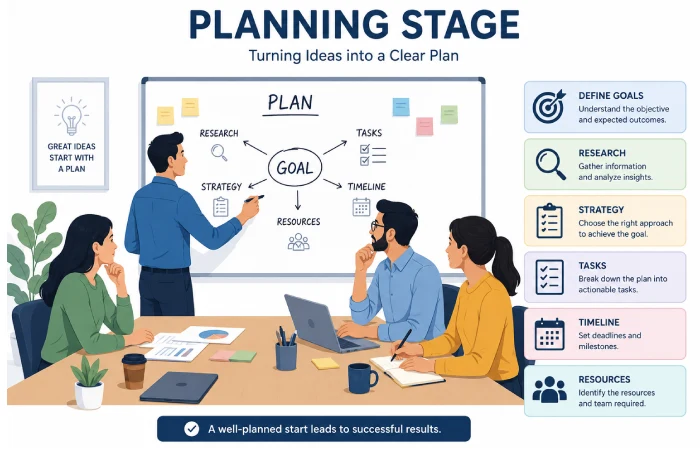
The planning phase the first part of starting a business that is not merely important, but critical. A brilliant idea will fail if the market size is insignificant, its high cost, wrong location, or if business doesn’t fill an actual gap in market demand for a real customer problem, solution.
Before spending your capital, you need to know what you’re selling, who will buy it, what your rivals are doing and if the numbers add up, in the beginning anyway.
1. Define Your Business Idea
- Do you already have a hobby or pursuit you wish you can make a livelihood out of? Most entrepreneurs usually already have an idea of what is essentially their business idea and merely need to structure it into a business case.
- You have to categorize where your business falls into! It may fall into one of the categories above and some may have overlaps.
- Food and restaurants
- Retail
- Professional services
- E-commerce
- Technology
- Healthcare and wellness
- Education
- Beauty and personal care
- Construction
- Real estate
- Manufacturing
- Digital services
If you have no idea yet, scout around your neighbourhood, check out some problems customers always face in daily live. Old small businesses are another way.
Some examples of small businesses include:
- Clothing or accessories stores
- Laundries and dry cleaners
- Grocery stores
- Hairdressers and beauty salons
- Coffee shops
- Bakeries
- Pharmacies
- Shoe stores
- Tailor shops
- Greengrocers
- Butchers
- Digital marketing agencies
- Consulting businesses
- Online stores
The important thing is not simply to copy an existing business. Rather, look for the needs you want to satisfy in customers and for ways your business can satisfy that need more quickly, cheaper, more easily or more conveniently than anyone else.
2. Validate the Business Idea
An idea is just a start. Test for payment before you sink a lot in the idea. You can quiz your customers as to what they want, prefer, would want to pay for, and so forth as well as investigate what substitutes and current solution, they use.
You can validate an idea through:
- Customer surveys
- Interviews
- Competitor research
- Online searches
- Social media discussions
- Small test campaigns
- Pre-orders
- Trial services
- Landing pages
- Sample products
The objective is to collect evidence before making a major investment.
A business idea becomes stronger when you can identify a specific customer problem and demonstrate that your proposed solution addresses it.
-
Analyse the Environment
One key element to consider when determining your project’s direction is the environment the business will be in. Ever visited a shopping area where almost all the companies offer and sell exact things or services? Now you will certainly not blame opposition per-say – in reality too much of it will prevent people from buying coming here!
Know where you’d like to see your business operate and survey the other existing businesses in that vicinity.
Among the questions you have to be answering include; Which is going to be your biggest competition nearby?
What products/services do they sell?
What’s their pricing structure?
Who are the typical customers?
What’s to love about their products/services?
What are the pain points of their customers?
Is there a gap in the market?
Are there plenty of clients to go around?
You should also assess what kinds of products and/or services are missing in the local community. Perhaps there are numerous eateries at hand, yet no establishment offers a specific type of fare. Perhaps the local boutiques stock fashionable attire, but there are few selections in apparel for a specific type of client.
Identifying what holes exist in the market can help you more adequately tailor the products and/or services you offer.
4. Conduct Market Research
While market research through formal methods might offer specific insights, small businesses don’t necessarily need to spend money to conduct elaborate research.
Start with the easy and basic methods: survey on the local neighbourhood’s consumers; interview with target customers; competitor investigation; research online etc.
The outcome should clarify: Market size
- Customer demographics
- Customer purchasing behaviour
- Competitor pricing
- Demand for the product
- Industry trends
- Potential risks
- Growth opportunities
Market Research Your Market If your product or service is also beneficial to businesses in your area, talk to the people who work there and own them. They may let you know of possibilities an individual customer would not know. The purpose of any market research is not to ensure profitability, but rather to make as much of the unknown as possible known so you can be a more informed decision maker.
5. Choose the Right Business Location
With an idea of the market and how to do business, select an appropriate site based on the factors that matter to you: For brick-and-mortar businesses, location will significantly influence exposure, traffic, operating expenses, and long-term expansion.
To help you select a favourable location, look at:
- Accessibility
- Foot traffic
- Vehicle traffic
- Parking availability
- Nearby businesses
- Visibility from the road
- Local competition
- Rent or purchase costs
- Available space
- Utilities
- Zoning and permitted use
- Safety
- Future development in the area
A retail store may benefit from a busy commercial street, while a service business may be able to operate successfully from a smaller office or even remotely.
The space should also match your operational requirements.
However, not every type of company will require same type of facilities. For instance, a restaurant will have to focus on a parking lot, and a dressing room, while a warehouse-based business should look at the loading capability and accesses.
6. Decide Whether to Rent or Buy
Most people end up having to make one of the most important monetary decisions they may ever make-whether they’ll be buying a property or renting a room.
Buying property can provide long-term control over the space and potentially create an asset. However, it also requires significant capital and may reduce the amount of money available for operating the business.
Renting generally requires less initial capital and provides flexibility, particularly for a new business that has not yet established consistent revenue.
Compare:
- Initial investment
- Monthly payments
- Maintenance costs
- Taxes and fees
- Lease conditions
- Renovation requirements
- Expected business growth
- Long-term property value
Do not select a destination for aesthetic appeal alone. Ensure the investment involved suits your likely income.
7. Create a Realistic Business Budget
A business budget helps you understand how much money you need before opening and how much you will need to operate each month.
Your initial budget may include:
- Property deposit
- Rent or purchase costs
- Renovations
- Equipment
- Furniture
- Inventory
- Licenses and registrations
- Insurance
- Utilities
- Website development
- Branding
- Advertising
- Employee costs
- Professional services
- Software
- Emergency reserves
Divide your costs into fixed and ongoing
The purchase of a piece of equipment for example would a one off fixed cost and your regular costs like the shop rent, staff wages, electricity, internet and any subscription services for software etc, would fall into the variable or recurring expenses.
It also works helps with your break even.
8. Determine Your Break-Even Point
The break-even point shows how much business you have to conduct before you make a profit and offset your costs. A simple formula is Break-Even Point in Units = Fixed Costs/Contribution Margin Per Unit For example, if monthly expenses include $5,000 in fixed costs and $50 is made on each sale as a contribution margin, you’d have to conduct around 100 sales to break even. It can also be a method for gauging if expenses are too high, sales targets reasonable or a particular product price is appropriate.
You may also want to consider the return on your investment.
A business analysis can reveal ROI, which will determine if your money is earning a justifiable amount of return on your investment.
9. Establish the Business Name and Objectives
Who will you be selling your product or service to?
The importance of identifying your target market stems from the fact that they will affect how you brand, price, communicate, design, market and sell your product or service. You should not try to sell to “everybody” but rather to one specific customer persona.
Consider:
- Age
- Location
- Income
- Occupation
- Interests
- Purchasing behavior
- Problems
- Needs
- Budget
- Buying preferences
Your company’s name also should match your target market. Youngsters will use a different language in words as well as style to communicate than to professionals advising on financial consulting. Simultaneously determine your business goals clearly.
Your objectives might include:
- Reaching a specific revenue target
- Acquiring a certain number of customers
- Opening a second location
- Launching a new product
- Increasing online sales
- How to achieve profit in a specific time frame.
Measure so you can assess progress Make your goals specific, measureable so you can easily track progress.
10. Analyze the Competition
Competition analysis, sometimes referred to as benchmarking, involves observing other businesses and understanding what works for them.
The purpose is not to copy competitors. Instead, identify opportunities to improve upon what already exists.
Study:
- Their products
- Prices
- Customer service
- Marketing channels
- Website
- Social media
- Reviews
- Promotions
- Brand positioning
- Customer experience
Negative customer reviews are especially handy since you can find solutions to the issues they point out. If customers consistently note slow service, difficult ordering or communication problems, those can be features you turn into a selling point.
11. Create a Business Plan:
Your business plan brings the major elements of your project together in one document.
Your business plan brings the major elements of your project together in one document. For additional guidance, the U.S. Small Business Administration’s business plan guide explains the key sections and formats to consider.
A basic business plan should include:
Executive Summary:
Discuss the business idea, target customer, the product or service being offered and key aims.
Business description:
Detail how the business works, what problem is being addressed and will likely consist of the product/service with an explanation of where it will sit in the market.
Market Analysis:
Discuss customers, market sectors, competitors and market potential.
Products or Services:
Discuss what will be sold, along with the features of the product/service and benefits associated with using it.
Marketing plan:
How customers will be acquired and how sales will be generated.
Operational Plan:
Will detail location/premises, equipment/technology, suppliers and staff if applicable. What the physical day-to-day operation of the business will look like is illustrated here.
Financial plan:
Include; starting up costs, operational costs, revenue, prices and future cash flow predictions. An explanation of break-even point is also needed.
The business plan does not necessarily need to be hundred pages long, more importantly the plan should be realistic and helpful in the decision-making processes.
Execution stage:
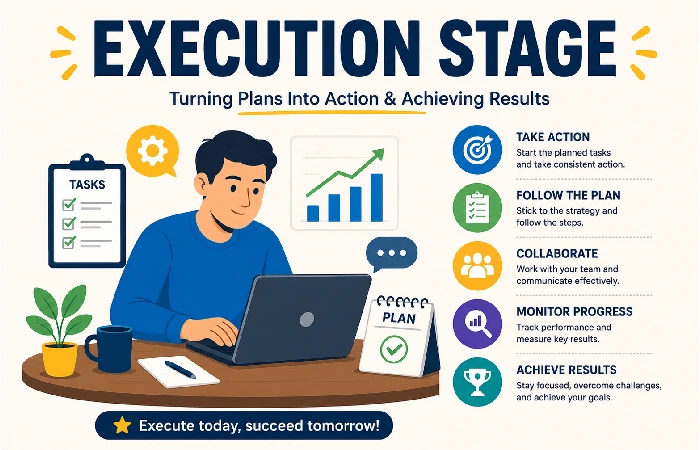
Once planning is finished and the plan is constructed, it becomes possible to transform the concept into a business.
12. Complete the Legal and Administrative Requirements
Each requirement is different based on the country you will operate, each state, city, business type and sector. In regard of circumstances;
You might want to take care of the following:
- Business registration
- Tax registration
- Business licenses
- Industry permits
- Insurance
- Employment requirements
- Health and safety requirements
- Intellectual property
- Contracts
- Data protection
- Local zoning requirements
Before launching your business be sure to research all rules and regulations that govern that type of business and seek advice from an accountant and/or lawyer if you deem it necessary.
13. Arrange Business Financing
Not every business requires the same level of capital.
Possible sources of funding include:
- Personal savings
- Business partners
- Investors
- Bank financing
- Government programs
- Business grants
- Crowdfunding
- Revenue from an existing business
Don’t take on additional loans when the company cannot possibly repay it.
Prepare at least three financial scenarios; conservative, expected, and optimistic. You should use this to be prepared if there are fluctuations in sales or operational costs.
14. Set Up Your Operations
Your business needs reliable systems before you begin accepting customers.
Depending on the business, this may include:
- Suppliers
- Inventory management
- Payment systems
- Accounting
- Customer support
- Order processing
- Delivery
- Employee scheduling
- Quality control
- Data management
Write down key processes so that employees understand the correct way to undertake tasks.
Systems will also cut down errors and allow for future scalability if needed.
15. Build Your Brand
Your brand is more than your logo.
It includes the overall experience customers associate with your company.
Develop consistent:
- Brand name
- Logo
- Shade
- Typography
- Messaging
- Packaging
- Website
- Social media presence
- Customer experience
Your branding should communicate what makes your business different.
-
Build an Online Presence
Although your brick and mortar should be able to bear the brunt of your workload, your online presence should not be ignored or overlooked at all.
At a bare minimum, think about…
- A professional website
- Business email
- Social media profiles
- Local business listings
- Online contact information
- Product or service pages
The website should accurately detail your product or service, to whom you target, reasons for customers to do business with you and contact details (or purchasing method) to engage with the business.
Search engine optimization can benefit business greatly too; finding the businesses from potential clients searches.
-
Create a Marketing Strategy
Greatest products alone do not create buyers. So, you have a strategy of approaching this customer.
Here’s what your marketing strategy could include:
- SEO
- Content marketing
- Social media
- Email marketing
- Paid advertising
- Influencer marketing
- Local marketing
- Partnerships
- Referral programs
- Events
- Public relations
Channels you select should reflect where your target customers already do business or spend their time.
As a general example, a local restaurant may be more concerned with local search, social media engagement, review sites and community marketing. A B2B software company would much more likely concentrate on search engine optimization (SEO), content marketing, e-mail communications and professional networks.
18. Prepare for Product or Service Launch
The Right Product or Service – Ensure Your Offering Is Ready Before Your Big Debut.
Build a launch checklist including these items:
- Product quality
- Pricing
- Packaging
- Website
- Payment methods
- Inventory
- Customer support
- Marketing materials
- Staff training
- Delivery processes
Alternatively, go for a soft launch First… you could potentially go with a ‘soft launch’ where you ‘trial run’ the business, but just with a smaller group.
Customers can identify issues you may have missed when planning your launch business.
19. Launch Your Business
Now that your systems are in place, release the service or product, and start tracking your results. Nothing is guaranteed to go perfectly the first day, and over the first few weeks and months.
Be very observant of your:
- Customer comments/reviews
- Sales
- Website traffic
- Conversion rates
- Marketing spending
- Cost of acquiring customers
- Repeat sales
- Profit margins
- Cash flow
Use all this data to make improvements
20. Measure Business Performance
Launching your Business, that’s only the start; savvy entrepreneurs are always monitoring progress.
Some metrics might consider:
Revenue
How much money the business is generating?
Profit Margin
How much remains after expenses?
Customer Acquisition Cost
What does a new customer cost you?
Customer Lifetime Value
Average lifetime revenue per customer?
Conversion Rate
How many prospects turn into paying customers?
Return on Investment
What level of returns are you seeing against your outlay?
These figures that you follow will guide you into what works.
Common Mistakes for Starting A Business
Several new entrepreneurs make needless errors.
Starting Without Research
Your business idea might be amazing, yet very few are looking for it. It’s important to test the market before going into deep investment.
Underestimating Expenses
Unforeseen expenses can take cash-flow problems to another level. Set up cash flow reserves whenever possible.
Trying to Sell to Everyone
Normally a well-defined target market means that marketing positioning can be made easier.
Ignoring Competitors
From competitor research, we understand better customer needs, pricing issues, and missing areas.
Spending Too Much on the Launch
A big launch doesn’t ensure lasting success. Concentrate on a sustainable customer acquire program.
Neglecting Customer Feedback
Customers can give information to us regarding the quality, price of products, service and their unmet needs.
Mixing Personal and Business Finances
As much as possible, separate personal from business financial matters. Good record keeping makes accounting and financial decision making easier.
Growing Too Quickly
Problems can also arise from growth if your facilities, finances, people or customer service ability can’t keep up with increased demand.
How to Make Your Business Successful
There isn’t just one formula that will ensure your business succeeds. However, success in business often requires similar, defining features.
Understanding the customer needs, solving the right problem, careful cash management, consistent quality and market flexibility.
Take building solid base before focusing on growth and acceleration
Your long-term strategy should include:
- Understanding customer needs
- Improving products and services
- Maintaining healthy cash flow
- Building customer loyalty
- Monitoring competitors
- Investing in effective marketing
- Developing reliable processes
- Training employees
- Measuring performance
- Adapting to market changes
I would say the outcome of profit has been a deliberate result rather than that that followed simply from increased volume.
Frequently Asked Questions about Starting a business.
“How much do I need to begin my company?”
It is not an all-or-nothing sum. A house base service business needs very little capital outlay whereas a restaurant, shop or business where goods are manufactured, can have quite high initial outlays.
Estimate your start costs and some months of working capital before you consider how much financing is required.
What is the first step in starting a business?
Finally, and also quite importantly you will need to come up with an idea and also to ensure the idea is feasible for business. Through research, one must find and verify: if there is a demand or a solution in place of which people wish to avail, and who exactly are the customers. Furthermore, one also has to find out the strength and weaknesses of their rivals: Competitors.
Do I need a business plan?
It’s not mandatory to have a business plan for all small businesses, but it sure is worthwhile to do one. All the research you do on market conditions, strategic goals, your operations and financial forecasting will come together in a business plan providing you with a useful tool for future decisions.
Should I rent or buy a business property?
It really does depend on your investment capital, the nature of your business and business model, projected rate of growth, local real estate trends and your desired holding period. Key Takeaway For renters, its flexibility and convenience, where owners gain property value as well as their investment.
How do I find customers for a new business?
Determine where your potential customers spend their time. This may include: search engines, social media, email, forums, the community, partners or strategic alliances, events, or even paid media (depending on the business).
How long does it take for a new business to become profitable?
It’s not a fixed dated. Factors such as industry, price, operations cost, demand of product or services, and competition, and management can contribute. Set up financial projection and observe actual performance closely.
Final Thoughts
Step One: Creating a successful new business necessitates a good idea and lots of energy, yet it demands a level of discipline and strategy that goes further. You’ll need to do your research, get your finances in order, understand your customers, and implement relentlessly. Step One: Understand the Opportunity Start by clarifying your business idea, identifying the demand for it, researching your environment and the competition, deciding on the location (physical or online), developing a budget, defining your customers, and building a business plan.
Step Two: Take Action After the planning is done and you’re ready to start your business, your next actions will be focused on getting setup with the legal and administrative setup required, securing any finance, making the place work, building the brand and the company presence, developing and putting together a marketing plan, and preparing to launch.
Post-Launch Step Three: Maintain & Adapt Once you’re off to the races, don’t forget about continuously checking on how the business is performing, and listening closely to what customers think. What your initial plans become rarely looks anything like what actually happens as you gain knowledge. The best businesses evolve, and this will likely happen for you too. If you have an idea you’re eager to pursue, take the first crucial step: turn it from simply an idea into a thought out and implemented plan.
